


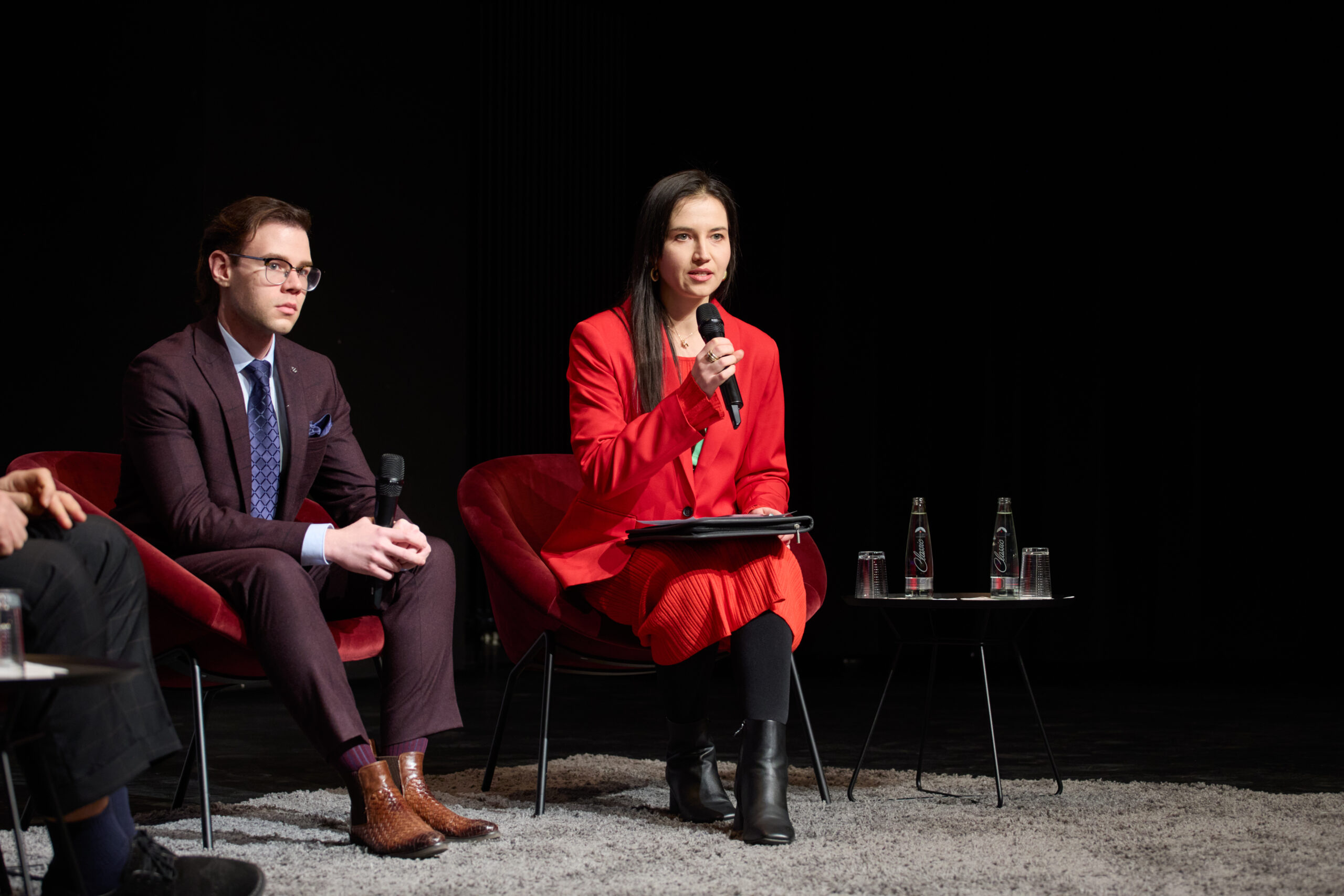
February in Munich has its own grammar. The corridors of the Security Conference don’t just carry conversations — they carry consequence. This year felt different from anything I’ve experienced over the past decade. Sharper. More compressed. Every panel, every rushed coffee between sessions orbited the same unspoken pressure point: not whether European security needs to be rebuilt, but whether the people in that room can move fast enough to matter.
Altogether, the side event at Amerikahaus Munich — Bridging Generations: Ukraine and Europe’s Security Architecture — underscored that structural shifts are already in motion, and that youth (across Europe, including Ukraine) is here to accelerate them.
Consider, for instance, the opening of Ukraine House as a declaration. Every head of state who walked through that pavilion could understand — whether they acknowledged it openly or not — that the architecture we have been debating in abstract terms is already being poured into concrete somewhere to the east. While Ukraine is petitioning for a seat at the table, it has also begun constructing its own.
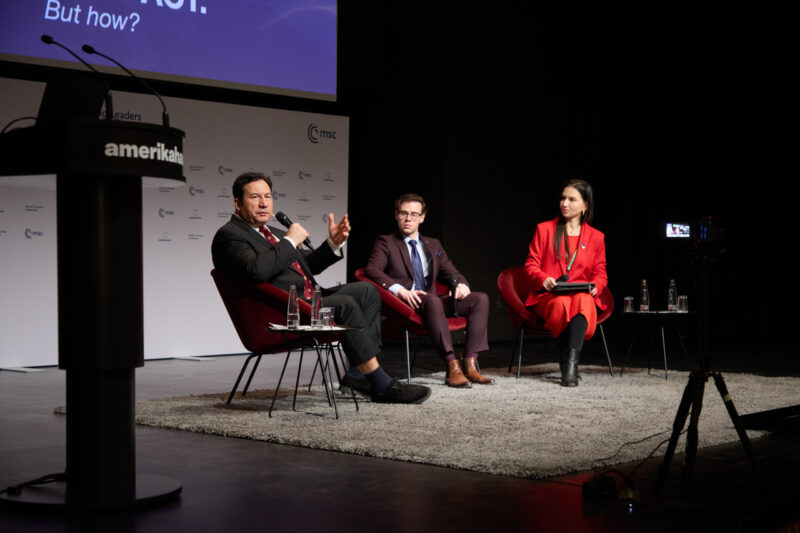
Jovan Jovanovic and
Mark Voyger ; WEF Global Shapers Youth Survey
Why Ukraine Changed the Security Conversation
Russia’s full-scale invasion of Ukraine in February 2022 did not simply reignite a war in Europe. It shattered a foundational assumption that had quietly governed European strategic thinking for three decades: that serious, large-scale conflict was a managed risk rather than a present Reality.
What followed was not only a military confrontation, but a civilizational test — of democratic resolve, of institutional capacity, of the willingness to defend the values Europe claims to stand for. Ukraine passed that test under fire, every day, while much of Europe was still debating whether to send helmets.
Four years on, the conversation has shifted fundamentally. Ukraine is no longer discussed primarily as a victim requiring rescue, nor even as a partner requiring support. It is being recognized — slowly, imperfectly, but unmistakably — as a force that has transformed the European security landscape from within. The frontline is also a laboratory. The war is also a school. And Europe, if it is serious about its own future, needs to be an attentive student.
Insights from the Panel Discussion
The panel we convened at Amerikahaus brought together Ukrainian practitioners, European defense analysts, and a younger generation of security thinkers who are increasingly setting the terms of the debate. What struck me, moderating the discussion, was how little patience the room had for the familiar language of “partnership” and “support” — and how clearly participants were thinking in structural terms.
There was broad agreement that Ukraine has accumulated wartime knowledge and operational experience that no European think tank or defense ministry can replicate from the outside. From drone warfare to civil-military coordination under sustained attack, from cyber defense to the psychological resilience of a population that has chosen to fight rather than flee — this is knowledge with a direct bearing on European security planning. The question is whether Europe’s institutions are designed to absorb it.
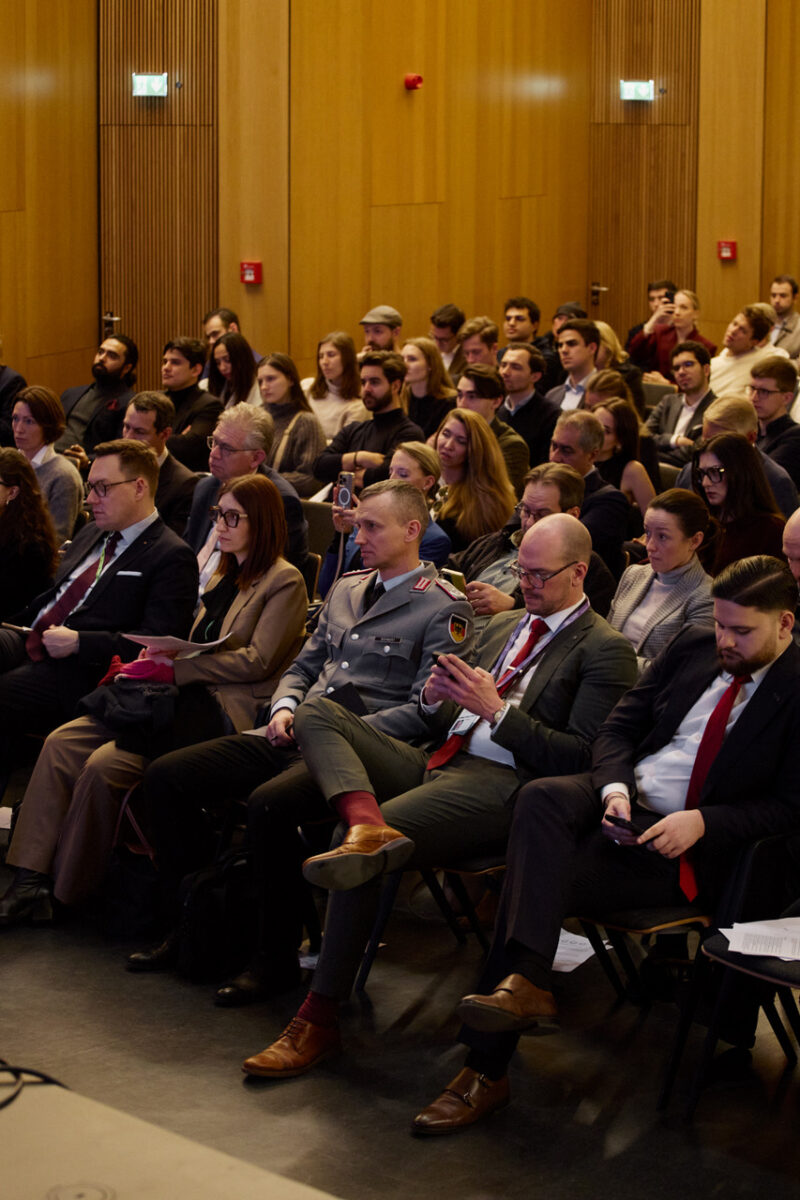
Equally striking was the generational dimension of the conversation. Younger participants — Ukrainian and European alike — spoke with a clarity that sometimes eluded their more senior counterparts. They are less attached to the institutional habits of the Cold War era, more attuned to the networked, hybrid, and technological character of contemporary threats. For them, the integration of Ukraine into European security structures is not a long-term aspiration. It is an immediate strategic necessity.
 Three Strategic Lessons for Europe
1. Ukraine as Europe’s Security Laboratory
Ukraine has become the world’s most intensive testing ground for twenty-first century warfare. The evolution of drones and autonomous systems on the Ukrainian battlefield is advancing faster than any defense procurement cycle in NATO can track. Civil-military resilience — the capacity of a society to absorb, adapt, and continue functioning under sustained attack — has been tested and refined in real time. Ukraine’s defense technology ecosystem is producing innovations under extreme pressure that would take peacetime Europe a decade to develop through conventional procurement.
Europe must stop treating these lessons as temporary wartime adaptations and begin institutionalizing them as permanent contributions to collective defense knowledge. This means creating formal mechanisms for transferring Ukrainian operational experience into NATO doctrine, EU defense planning, and national security curricula. It means embedding Ukrainian expertise — not just Ukrainian equipment requests — at the center of European defense cooperation.
2. Rethinking the Foundations of European Security
For decades, Europe’s security architecture has been shaped by a model that combined transatlantic guarantees, NATO-led territorial defence, and a gradual deferral of deeper questions around European strategic autonomy. While this framework delivered stability, it was not designed to function as a permanent substitute for Europe’s own strategic capacity.
Today, this model is evolving. The war in Ukraine has accelerated a reassessment of how security is generated, sustained and shared across the continent. What is emerging is not a departure from transatlantic cooperation, but a recognition that such cooperation is most effective when underpinned by stronger European capabilities and greater internal coherence.
In this context, Ukraine’s role is becoming increasingly central. Its military capabilities, rapidly evolving technological ecosystem, demonstrated societal resilience and accumulated operational experience represent more than elements of support — they contribute directly to the foundations of Europe’s future security architecture. The ongoing war has positioned Ukraine not only as a frontline state, but as a source of innovation, adaptation and institutional learning.
This shift invites a broader reframing. Rather than viewing Ukraine primarily through the lens of partnership or future integration, there is growing recognition of its role as a constitutive element within an emerging European security system. For policymakers and strategic planners, this implies moving beyond inclusion narratives towards models of co-development and shared ownership of Europe’s security future.
3. A Generational Shift in Security Thinking
Perhaps the most underappreciated dimension of the current moment is the generational one. A new cohort of security thinkers, practitioners, and leaders is entering the debate — and they see the world differently.
They have grown up with hybrid threats, disinformation campaigns, and the seamless integration of civilian and military domains. They are less interested in deterrence as an abstract doctrine and more focused on resilience as a lived practice.
This generation insists on the democratic legitimacy of defense policy — on the idea that security arrangements must be grounded in genuine public consent, not technocratic design. They emphasize the role of civil society, technological innovation, and societal participation as integral to security, not supplementary to it. And they reject the binary between military and non-military instruments that has long constrained European strategic thinking.
The panel at Amerikahaus made this tangible. It was not simply a discussion between experts. It was a conversation between different generations of a security community that is actively reconstituting itself.
Shaping Europe’s Security Future: Integration, Knowledge and Leadership
The strategic implications for Europe are immediate and far-reaching. Addressing them requires coordinated progress across multiple dimensions, often at a pace that challenges traditional institutional processes.
Institutional integration emerges as a central pillar. Ukraine’s pathway towards membership in the European Union can be understood not only as a political trajectory, but as a core component of Europe’s evolving security architecture. In this context, approaches that delay or heavily conditionalize accession risk overlooking the strategic reality: key reforms are already being tested and implemented under the most demanding circumstances. Ukraine’s ongoing experience reflects a practical demonstration of European values in action, suggesting that integration and transformation can proceed in parallel.
Knowledge transfer at scale represents a second critical dimension. European institutions — including NATO, the EU and bilateral partnerships — have an opportunity to develop structured mechanisms to absorb and integrate Ukraine’s operational experience. This extends beyond capabilities and equipment to encompass doctrine, organizational adaptability, civil-military coordination and broader societal resilience. Initiatives such as secondments, joint exercises and collaborative planning frameworks can serve as foundational instruments in this process.
Generational investment will shape the long-term trajectory of European security. The next cohort of leaders is emerging in real time, shaped by unprecedented challenges. Creating pathways for Ukrainian professionals — across security, policy and analytical domains — to engage within European structures can contribute to a more integrated and forward-looking leadership ecosystem. In this framing, participation is not defined by wartime necessity alone, but by the shared task of co-designing Europe’s future security landscape.
Conclusion: Co-Architects, Not Beneficiaries
Leaving Munich, I carried with me one conviction above all others: that Europe’s security architecture is not being designed in Brussels or Berlin or Paris. It is being forged on the frontlines of Ukraine, in the improvised command posts and technology labs and civil society networks of a country that has decided to fight for its future — and, in doing so, to fight for Europe’s.
The debate about whether Ukraine belongs in Europe is over. The debate about how Ukraine should be integrated is urgent but answerable. What remains, and what demands a fundamental shift in European strategic culture, is the recognition that Ukraine is not a country to be welcomed into an existing architecture. It is a country helping to build the architecture that does not yet fully exist.
Europe’s future security architecture will not simply include Ukraine. It is being built today with Ukraine at its core.
By Natalia Iskovych