


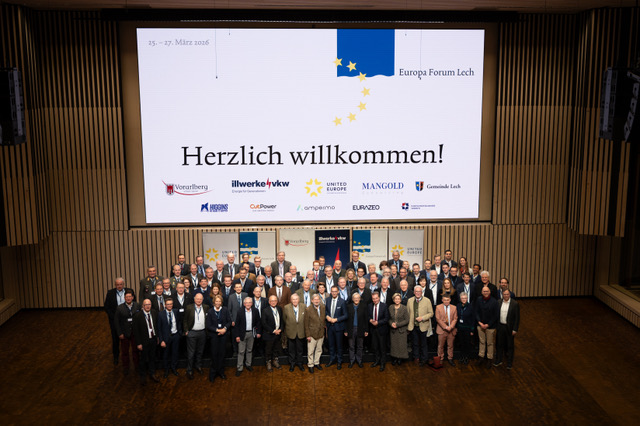
The Europa Forum Lech was founded in 2011. Former Austrian Chancellor Wolfgang Schüssel brought the European idea to Vorarlberg with the aim of creating a platform for open, honest, and strategic dialogue on European policy.
As every year, United Europe invited selected members and partners to the Europe Forum at Arlberg from March 25 to 27. Günther H. Oettinger opened the forum with a candid and incisive welcome address. He painted a compelling picture of Europe’s current situation and issued a clear warning: “We are heading toward a global financial crisis!”
Europe, he argued, finds itself caught between growing geopolitical pressure, economic uncertainty, and a gradual loss of competitiveness. At the same time, Oettinger coupled his analysis with a clear call to action: Europe must make more decisive use of its strengths and stop postponing necessary reforms.
This year again, the forum brough together high-ranking representatives from politics, business, and academia. Special thanks go to the sponsors, as well as the mayor Gerhard Lucian and Governor Markus Wallner. We also extend our sincere gratitude to Dr. Christof Germann, CEO of illwerke vkw, for the long-standing and reliable partnership.
A World in Transition
Dialogue between politics, science, and business is more important today than ever before. The global situation is tense – perhaps more tense than at any time in recent history.
The transatlantic partnership is under strain. The United States remains a partner, yet its current economic policy – characterized by tariffs and protectionist measures – places a significant burden on the global economy. At the same time, Europe must not lose sight of the fact that cooperation with the US remains necessary.
Even more dramatic is Russia’s war against Ukraine. Putin is not only waging a war of aggression against a sovereign nation but it is also attacking the very foundation of Europe. Ukraine is defending not only its own freedom but also our shared security. The danger increases with distance: the farther away one is geographically, the less urgent the threat often appears. Yet a Russian breakthrough would have severe consequences for all of Europe.
Systemic Competition: Europe between the US and China
At the same time, global competition is intensifying. China has caught up in many areas – and surpassed Europe in most. This is no longer just about economic strength, but about a comprehensive competition between systems:
- Democracy vs autocracy
- Social market economy vs state – controlled models
- Freedom vs control
Europe faces a strategic choice: with or without the United States, but always as a defender of democratic values.
Europe’s Economic Reality: Stagnation, Inflation, and Debt
The economic figures are sobering:
- Stagnation
- Inflation and high energy costs burden companies and households
- Energy prices affect the entire value chain – from industry to food production
At the same time, public debt in Europe is rising sharply. The Maastricht criteria (60% debt to GDP ratio, 3% annual deficit) are being significantly exceeded.
- France: over 110%
- Austria: around 90%
- Germany: over 80%
The result: rising interest burden, shrinking fiscal space – and the very real risk of a global financial crisis.
Europe’s Core Challenge: Security and Competitiveness
Ultimately, everything comes down to two key issues:
Security
Compared to other global players, Europe appears vulnerable. Despite a population of over 500 million, it often lacks strategic assertiveness.
Competitiveness
While the US economy grows by around 2.5% annually, Europe lags behind at roughly 1%. At the same time, costs, bureaucracy, and regulatory burdens continue to rise.
The Need for Reform: Reducing Bureaucracy, Strengthening Innovation
A recurring theme in Lech was the excessive bureaucracy in Brussels. The multitude of regulations and delegated acts hampers innovation and economic dynamism.
Europe needs:
– Less bureaucracy
– Faster decision-making processes
– Stronger investment in research and development
Programs such as Horizon Europe are an important step – but they must be developed with a stronger international focus, including closer cooperation with leading universities such as Cambridge, Oxford, and Zurich.
The Key Factor: Dialogue
One of the central messages of the Europa Forum remains:
Europe needs a stronger dialogue between politics and business.
In recent years, this exchange has increasingly come under pressure. Conversations between industry and policymakers are often viewed critically or even with suspicion. This leads to a dangerous imbalance.
- Politics without economic understanding
- Business without political awareness
In other regions of the world, such dialogue is taken for granted – in the United States as well as in China. Europe, by contrast, has created an artificial distance.
The barrier must be dismantled.
CONCLUSION: The Courage to Take Responsibility
The Europa Forum Lech makes one thing clear: Europe stands at a turning point.
The challenges are immense – geopolitical, economic, and societal. Yet the potential is just as great. What matters now is whether Europe can summon the courage to:
- critically reassess itself
- implement reforms decisively
- and strengthen dialogue among all relevant stakeholders
“The courage to demand more of ourselves,” as Günther H. Oettinger put it, captures the essence perfectly.
Europe must dare to do more!