


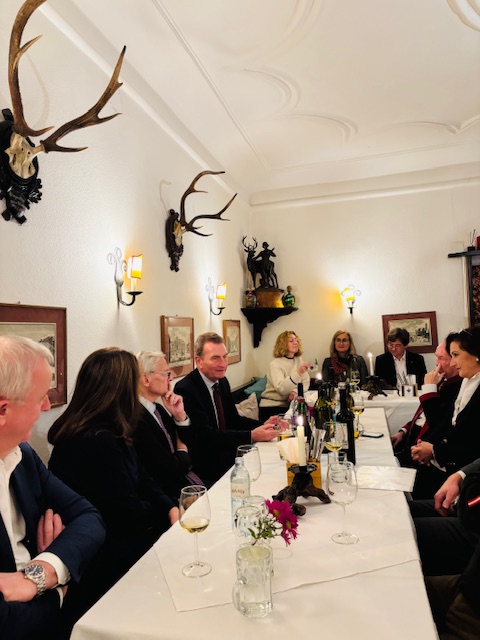
At the Political Stammtisch in Vienna on 12 November, United Europe President Günther H. Oettinger and former Austrian Chancellor Wolfgang Schüssel painted a stark picture of Europe’s geopolitical and economic situation. Their message was clear: Europe has reached a decisive turning point, and the choices we make now will determine whether we remain relevant in a rapidly changing global order.
1. A Clash of Systems in a New World Order
Authoritarian regimes share a common goal: to weaken the West—its democratic values, its freedoms and its model of a social market economy. Together, they represent more than one-third of the world’s population, and their political and economic influence is growing.
Europe must therefore be clear about what it stands for—and be prepared to defend its values, interests and security with determination.
2. Europe’s Competitiveness Is Under Pressure
The European Union’s growing vulnerability is particularly evident in global trade relations. While US exports in key sectors such as chemicals and pharmaceuticals enter Europe tariff-free, European goods imported into the United States face tariffs of 15 per cent. Steel, copper and other semi-finished products are subject to rates of up to 50 per cent in some cases.
Europe has accepted these terms.
Europe is also heavily dependent on other countries for critical raw materials. China controls around 90 per cent of these resources and accounts for a large share of the world’s refining capacity. This gives the country strategic leverage that extends far beyond economic considerations.
The evening’s stark assessment was:
“We are no longer competitive, no longer relevant. We have no power.”
Europe’s priorities for the coming years must therefore be unmistakably clear: security and competitiveness.
3. Joining Forces and Strengthening Europe’s Capacity to Act
In a world shaped by leaders such as Donald Trump, Xi Jinping and Vladimir Putin, as well as by emerging power blocs, Europe can succeed only by acting together. It must combine its strengths and reinforce the European level wherever joint action is more effective.
Future generations will judge us by how we responded to this historic turning point.
Yet Europe still holds itself back too often. Excessive bureaucracy places a burden on small and medium-sized enterprises, multinational corporations, start-ups and research institutions alike. Developing sustainable solutions therefore requires us to look beyond individual measures and consider the bigger picture.
4. The Wake-Up Call Is Working—but Europe Must Move Faster
Europe’s economy has made little progress since 2015. However, war, geopolitical tensions and disrupted supply chains have delivered a wake-up call that is beginning to produce change:
- European defence budgets are rising.
- Cooperation within NATO has become more important and more intensive.
- Defence efforts are being coordinated more closely at EU level.
- Awareness of strategic dependencies and fragile supply chains is growing.
The critical priorities are clear: raw materials, semiconductors, pharmaceutical resilience, artificial intelligence, space technology and secure European cloud infrastructure.
These sectors offer genuine growth potential. Pharmaceuticals and deep tech, in particular, are already emerging as powerful drivers of innovation. But potential alone is not enough: Europe must make decisions faster, invest more strategically and act with greater determination.
5. Innovation as Europe’s Lifeline
If Europe is to regain its competitiveness, it must create better conditions for the people and companies developing new ideas. This means:
- providing comprehensive support for innovators, researchers, universities and deep-tech companies;
- creating a genuine European capital market, including an open, funded pension system;
- reducing bureaucratic barriers; and
- placing greater trust in the younger generation and its entrepreneurial capabilities.
Europe possesses world-class research, highly skilled talent and strong companies. What it often lacks is the speed, capital and political courage required to turn good ideas into globally successful solutions.
6. Stagnation Is the Greatest Danger
Wolfgang Schüssel captured the evening’s central challenge in a single sentence:
“We love the status quo—and the status quo has now become the greatest danger.”
Europe faces a fundamental choice: do we want to preserve a comfortable system that is steadily losing influence? Or are we prepared to undertake the difficult reforms required to secure a safe, competitive and democratic future?
Change will demand a great deal from Europe. But inaction would be far more costly. Now is the time to take responsibility and actively shape Europe’s future.