


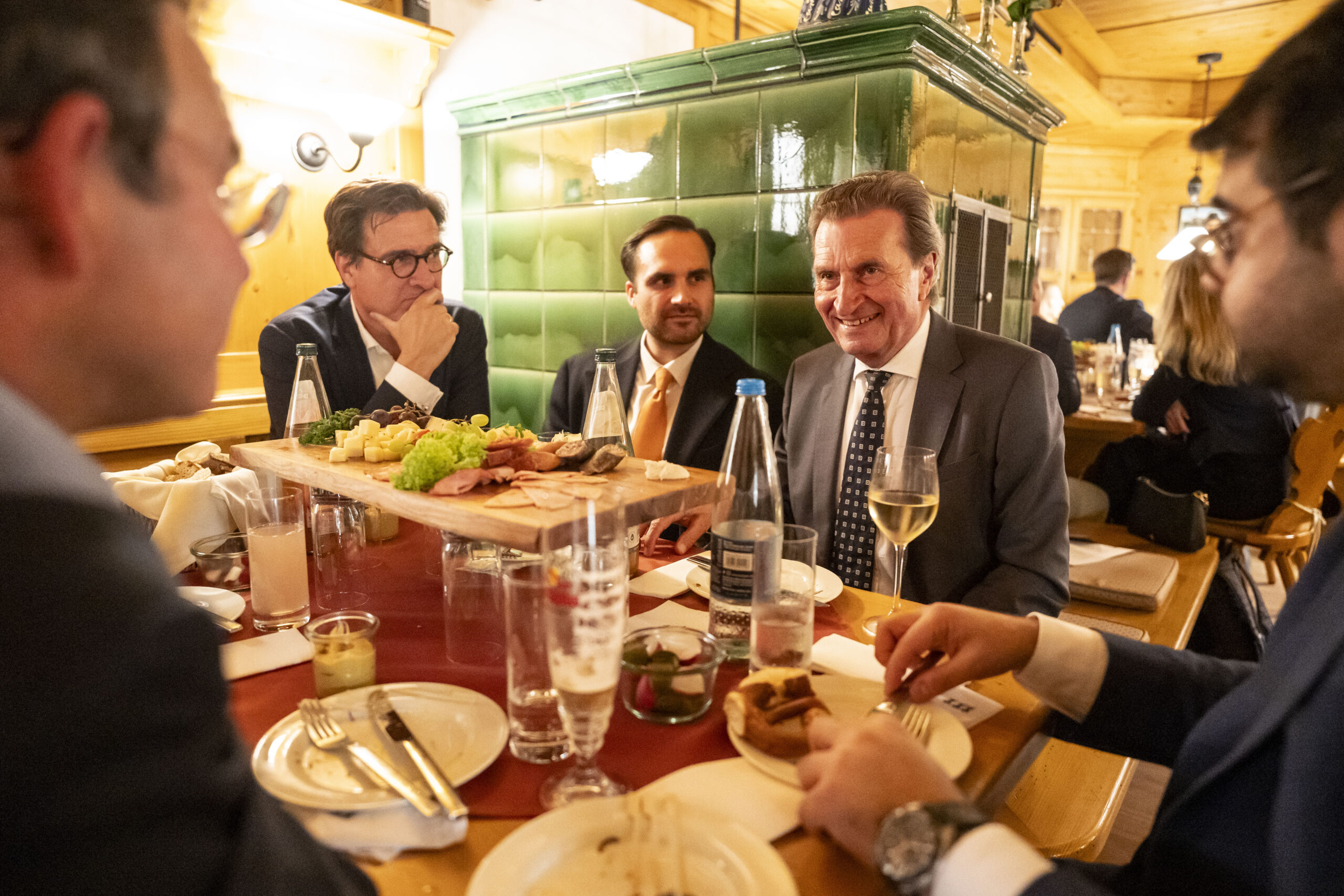
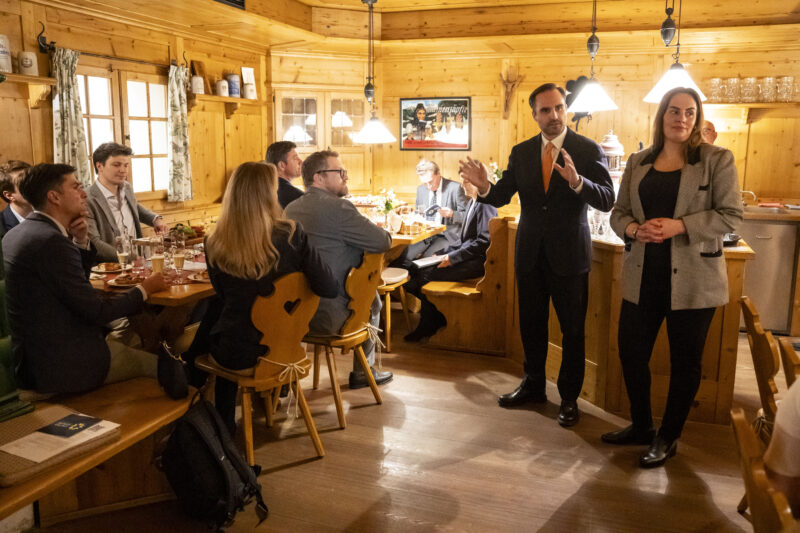
On 28 September, more than 40 guests came together at the Representation of the State of Baden-Württemberg to the EU for our Political Stammtisch in Brussels. The question of the evening was a simple one: What Next, Europe? The answer Günther H. Oettinger, President of United Europe, gave was sobering: to be realistic means to be concerned.
 Three Priorities on Brussels’ Agenda
Between now and the end of the year, three issues dominate the Brussels agenda: the next Multiannual Financial Framework (MFF), the future of the combustion engine, and, more relevant than ever, the omnibus packages to cut bureaucracy.
Priority 1: The Combustion Engine: Don’t Look Only at Paris and Berlin
The Minister Presidents of Bavaria, Baden-Württemberg and Lower Saxony, have written to the EU institutions. They call for the automotive sector to be stabilised. That means car, truck and bus production in Germany’s regions, and the many suppliers that matter to regions all across the European Union.
In capitals and metropolis like Paris and Berlin, the focus is on electric. But look at the growing markets around the world: Argentina, Brazil, India, Indonesia, Malaysia and others. Even in 2026 they lack the infrastructure to go electric. Oettinger’s conclusion was that Europe needs efficient combustion engines, and it must keep producing and exporting them after 2035.
Priority 2: Omnibus: Undoing What Was Done Yesterday
Normally, a directive or regulation is reviewed after 15 or 20 years, and then revised or repealed. Today, laws from 2023 and 2024 already have to be changed or dismantled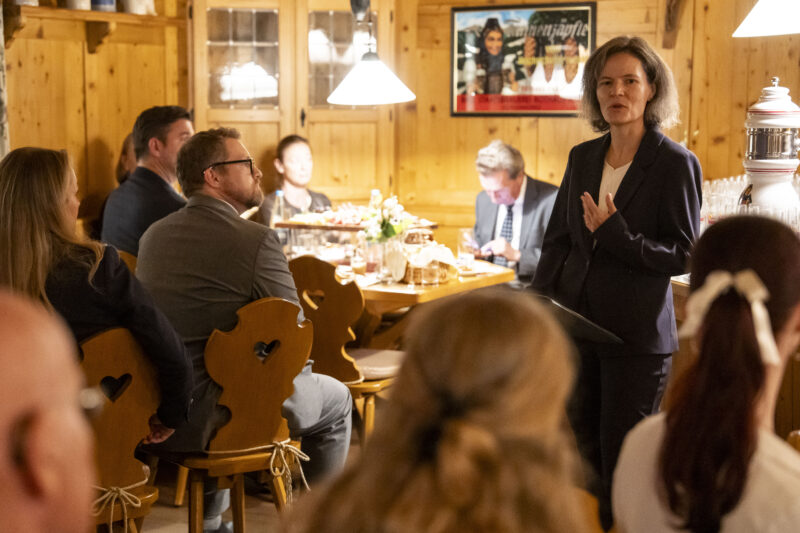 . CBAM or CSRD and the taxonomy are examples, along with other rules that demand reporting and calculations behind every product. All of them are highly bureaucratic.
The same Members of Parliament, heads of Unit and Directorates-General who passed these laws four years ago now have to consign their own work to the history books. “I have never seen such a situation in my whole political life” Oettinger said.
Priority 3: The MFF: Who Gets What, and How Much?
Member states want more money for regional policy and stable funding for agriculture. The open question is the overall size of the budget relative to GDP: more than in recent years, the same, or less? Whether a compromise can be reached before the end of the year remains to be seen.
2027: A Year of Elections, and of Uncertainty
Oettinger’s outlook for 2027 is sceptical. Seven member states go to the polls, including four of the largest: France, Italy, Spain and Poland. We will not know before the end of next year what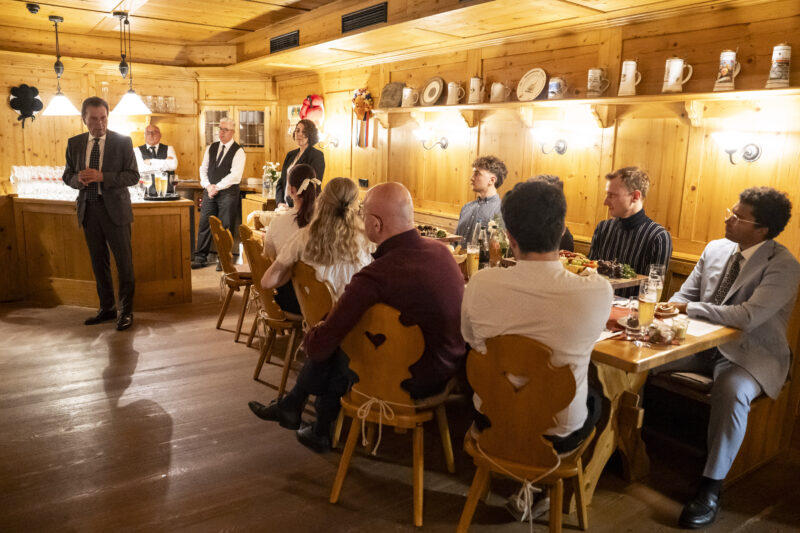 Europe’s governance will look like.
And governance is exactly what is at stake. On one side, Donald Trump and his erratic politics. On another, Xi Jinping, with China’s influence growing in Africa and beyond. On a third, Putin, who refuses to negotiate. Europe sits in a sandwhich position between them: strong and fairly united on the one hand, weak on the other.
The figures dont lie. In 2000, Europe accounted for around 25% of global GDP, roughly the same as the US, while China stood at 7%. Today the US holds about 28%, China has climbed to around 17% and Europe has fallen to 17%. Europe is no longer competitive. That concerns all of us: citizens, politicians and entrepreneurs. Europe has to do better and do more, and above all it has to invest more in research and development to get out of the sandwich position. Stagnation and recession make it hard to maintain our standard of living. When people worry about how to secure their standard of living for their families and their children, they can become angry. Angry voters turn to the far right or the far left.
In France, everything depends on the centre: Without a strong candidate from the centre, France will be divided between the extreme left and the extreme right. That would affect severely the governance direction of the European Union.