

Panel discussion · 3 November 2026, 17:00–18:30 · Haus der Wirtschaft (BDA), Berlin
For years, EU enlargement was a topic of patient rhetoric and slow procedure. That has changed. In 2026, the accession process has picked up a pace few would have predicted only a short time ago – and with it, the questions Europe can no longer postpone have become very concrete.
On 3 November, United Europe brings together policymakers from Berlin, Tirana and Pristina, alongside one of Germany’s leading analysts of the region, to ask what it will take to make enlargement succeed – for the candidates and for the Union itself.
Enlargement is back – and moving fast
The momentum is real. Montenegro has entered the final phase of its negotiations and aims to complete them by the end of 2026, with membership targeted for 2028. Albania is close behind: in mid-October it provisionally closed another negotiating chapter, its fourth this autumn, and is working towards concluding talks within the next year or so. The European Commission’s 2026 Enlargement Package, due in late October, is expected to set out accession roadmaps for frontrunners including Albania and Montenegro.
The EU’s Commissioner for Enlargement has called 2026 a record year for enlargement policy. For the first time in more than a decade, the Union is preparing not just to talk about new members, but to welcome them.
The strategic choices ahead
This acceleration brings difficult questions with it – and they are no longer academic.
Can a larger Union still act? A Union of 30 or more members will need to rethink how it takes decisions, funds its common policies and safeguards the rule of law. Reform of the EU and its enlargement are two sides of the same coin.
What do candidate countries need? Credible timelines, fair and transparent benchmarks, and tangible benefits along the way – from access to the single market to investment in infrastructure, energy and connectivity – are what keep reform-minded governments and citizens on board.
What does Europe gain? In a more contested world, enlargement is also a geopolitical decision. A stable, prosperous and integrated Western Balkans strengthens Europe’s security, its economic resilience and its weight in the world. For European businesses, it means larger markets, closer supply chains and new partners on the Union’s doorstep.
Voices from Berlin, Tirana and Pristina
Our panel brings these perspectives together:
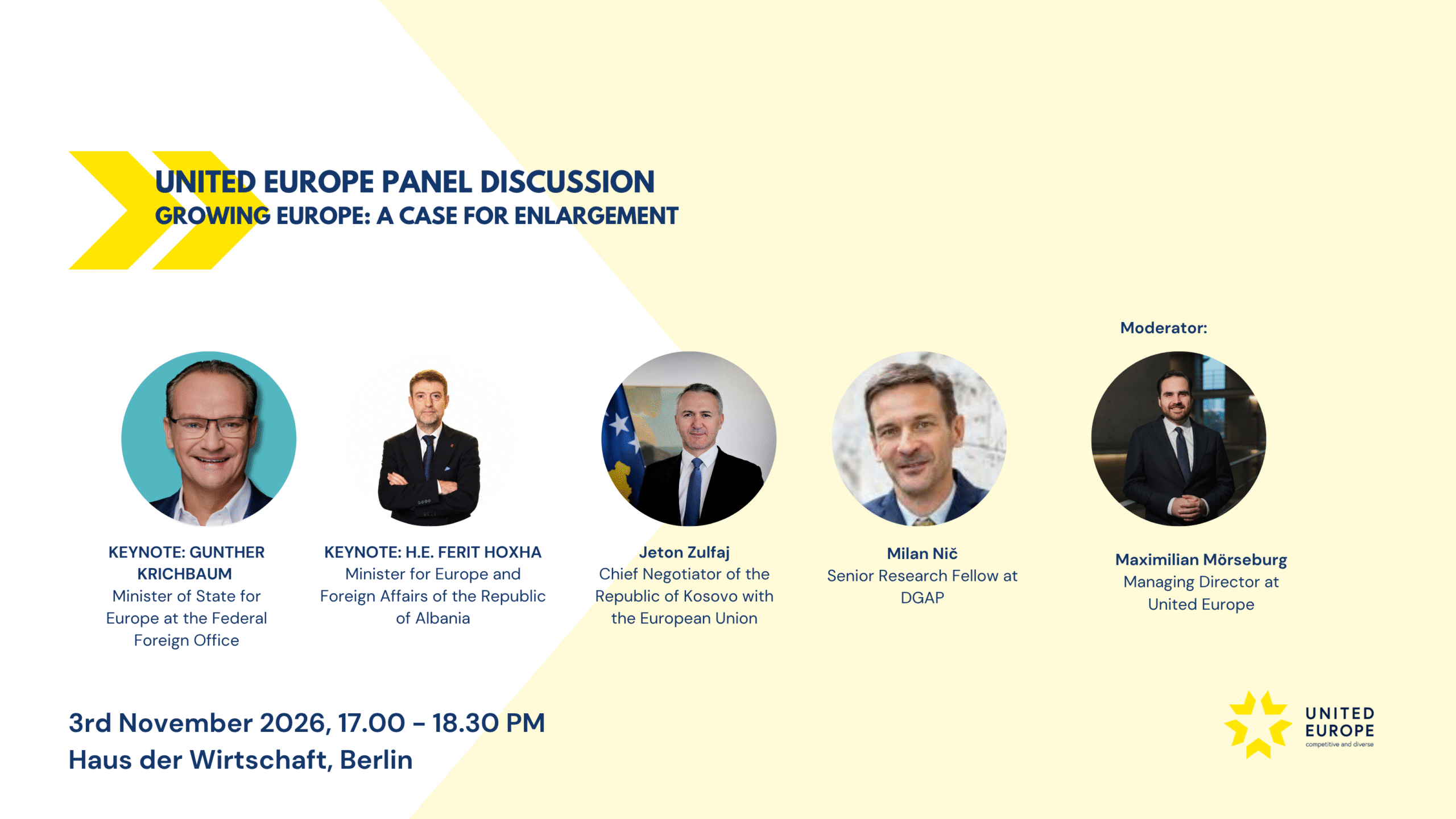
- Gunther Krichbaum, Minister of State for Europe at the Federal Foreign Office, on Germany’s role and the reforms the Union must undertake to be ready for new members.
- H.E. Ferit Hoxha, Minister for Europe and Foreign Affairs of the Republic of Albania, representing one of the frontrunners in the current accession process.
- Jeton Zulfaj, Chief Negotiator of the Republic of Kosovo with the European Union, on Kosovo’s European ambitions and the path still ahead.
- Milan Nic, Senior Research Fellow at the German Council on Foreign Relations (DGAP), with an analytical view on the region and the politics of enlargement.
The discussion will be moderated by Maximilian Mörseburg, Managing Director of United Europe.
Why this conversation matters now
The decisions taken in the coming months – in Brussels, in national capitals and in the candidate countries – will shape the European Union for decades. United Europe believes that business, politics and civil society must shape this debate together. That is why we look forward to an open and forward-looking exchange, and to your questions and perspectives.
Join us
Date: 3 November 2026 Time: 17:00–18:30 Venue: Haus der Wirtschaft, BDA | Confederation of German Employers’ Associations, Berlin
Registration is mandatory. Please register by 29 October at .
We look forward to welcoming you.