
• About Us
    • Mission Statement
    • Statutes
    • Board
    • Members
      • Corporate
      • Personal
    • Management
    • Become a Member
  • Programme
    • CEO Roundtable
    • Panel discussions and webinars
    • Cooperations
    • Stammtisch & Members’ talk
    • Lectures
    • Studies
  • Working Groups
    • Working Group 1: Powering Europe – Competitive Energy Transition
    • Working Group 2: Europe Future-Ready: Globally Competitive & Innovative capable
  • Young Leaders Advocacy Network
    • Mentoring Programme
    • Advocacy Seminars
    • Advocacy Webinars
    • Young Leaders Alumni
    • Young Leaders Voices
    • Rome Manifesto
      • The Manifesto
      • The Story behind the Manifesto
      • Partner Organisations
  • Events
  • DE
  • EN
  • DE
United Europe
United Europe
  • About Us
    • Mission Statement
    • Statutes
    • Board
    • Members
      • Corporate
      • Personal
    • Management
    • Become a Member
  • Programme
    • CEO Roundtable
    • Panel discussions and webinars
    • Cooperations
    • Stammtisch & Members’ talk
    • Lectures
    • Studies
  • Working Groups
    • Working Group 1: Powering Europe – Competitive Energy Transition
    • Working Group 2: Europe Future-Ready: Globally Competitive & Innovative capable
  • Young Leaders Advocacy Network
    • Mentoring Programme
    • Advocacy Seminars
    • Advocacy Webinars
    • Young Leaders Alumni
    • Young Leaders Voices
    • Rome Manifesto
      • The Manifesto
      • The Story behind the Manifesto
      • Partner Organisations
  • Events
  • DE
Join
  • News

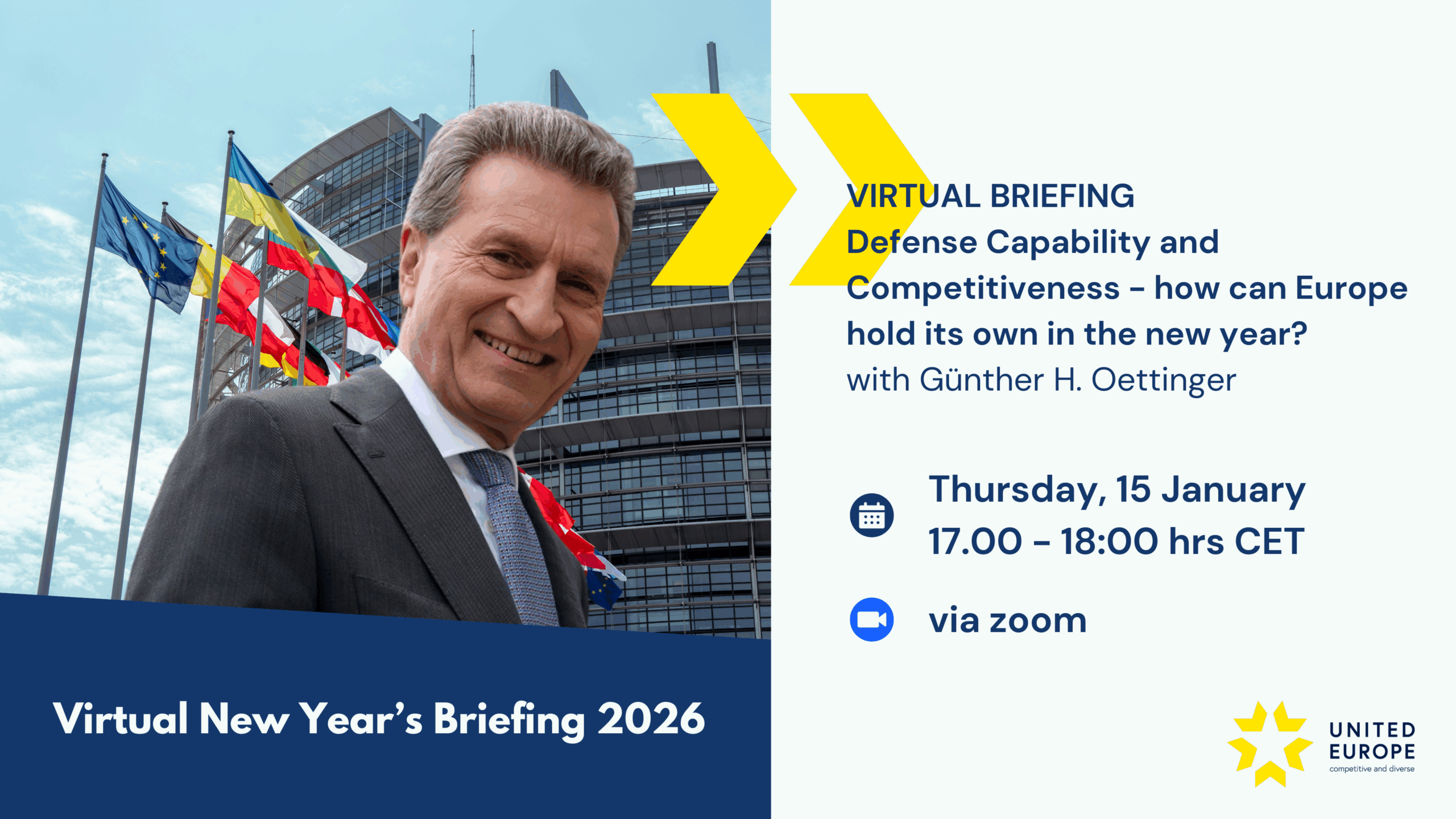
Review: Virtual New Year’s Briefing “Defense Capability and Competitiveness – How can Europe hold its own in the new year?”

  • January 21, 2026

Over 50 United Europe members joined us for our virtual New Years Briefing on “Defense Capability and Competitiveness – How can Europe can hold its own in the new year?” with Günther H. Oettinger.

Recent global developments present Europe with both encouraging progress and serious challenges. On the positive side, the long-awaited Mercosur agreement is finally near to completion, opening the world’s largest free trade area and creating significant opportunities for European exporters. Alongside this, promising trade initiatives with the UEA, India, and closer cooperation with the UK signal renewed focus on pragmatic economic partnerships at a time of shifting global alliances. Although the UK is not a member anymore, under Starmer it has become a close partner.

However, Europe faces growing geopolitical uncertainty. Developments in regions such as Venezuela, Iran, and Greenland, combined with increasingly unpredictable signals from the United States, highlight a critical weakness: We need world politics ability! Europe lacks a coherent and unified capacity to act decisively on the global stage. Europe has only two priorities: Strengthening security, defense capabilities, and military investment and – equally vital – Economic competitiveness. Sustained growth is essential to maintaining Europe’s social system and global influence.

Looking ahead, political risks loom large. Divisions within the EU over Mercosur and upcoming elections in France and Poland raise concerns about Europe’s future unity and stability.

Without clear leadership, effective communication, and a shared strategic vision, Europe risks losing both global relevance and internal cohesion.

In short, while there are reasons for cautious optimism, Europe must act decisively – on trade, security, and political unity – to shape its future rather than react to events beyond its control.

Members Interventions:

Members agreed that while Europe has long pursued a value-driven foreign policy, this approach must now be firmly anchored in interests, power politics, and real-world capabilities. Value-based policies remain relevant—particularly through trade agreements with democratic partners—but there was broad consensus that the era of lecturing other countries from a position of moral superiority has come to an end.

Several interventions underlined that values can only be credibly promoted if Europe itself is economically strong. Competitiveness, innovation, education, and sustained growth were identified as the foundation of a convincing European model and a prerequisite for projecting values internationally. Prolonged economic stagnation weakens Europe’s influence and has prompted a renewed focus on restoring competitiveness. In this context, excessive regulation and bureaucracy were criticized, with references to existing frameworks such as taxonomy rules, the deforestation directive, and CBAM, which were seen as having undermined economic strength. Rebuilding competitiveness was therefore described as essential not only for prosperity, but also for safeguarding Europe’s values globally.

A second intervention reinforced that security, defense, and competitiveness must be Europe’s top priorities, while adding global ambition as a crucial third pillar. In an increasingly competitive global environment, ambition was described as a prerequisite for relevance. Trade agreements were highlighted as a key instrument of this ambition, particularly with partners such as India, Mercosur, and Australia. Members also noted that public debates on trade are often misguided and that Africa is insufficiently addressed, despite being Europe’s direct neighbor and a region where China, India, and Russia are rapidly expanding their influence.

EU enlargement was identified as a central issue for the next three to five years and an integral part of Europe’s global ambition, strengthening its geopolitical weight and strategic reach. Across interventions, members stressed that values and power are not contradictory but mutually reinforcing. Internal stability based on democracy and freedom is a prerequisite for global influence, and portraying values and power as opposites only serves hostile actors and extremist forces seeking to weaken European Union.

Finally, members emphasized the importance of networks and partnerships. Beyond formal enlargement, Europe must actively align itself with strategic partners and relevant global networks to strengthen its position in international affairs.


  • share 
  • share 
  • share 
  • share 
  • save 
  • share 
  • share 
  • email 

p >=1 && c == 0

Other News
  • Invitation: “Hydropower for Germany’s Energy Security”
    • October 13, 2025
  • Review: Young Leaders Advocacy Seminar in Vienna “2024 Was A Decisive Election Year: What’s Next For Europe?” I Part 1
    • May 26, 2025
  • Smart Minds Move Europe: European Economic Conference #4 – Review 2025 and Save the Date 2026
    • June 30, 2025
„We are better together – economically, culturally and in every other way. Better together with 500 million people.“

Margaret Jay, Baroness Jay of Paddington
Member of the House of Lords

More prominent opinions
Search
Trending Posts
  • MSC Side Event Review: “Sovereign Europe Forum 2026 – The European Defense Union is the base.”
    • February 18, 2026
  • Voices from the Young Leaders Network: “Built With Ukraine at Its Core: How Europe’s Security Architecture Is Being Rebuilt — From the Frontline Up”
    • March 31, 2026
  • Voices from the Young Leaders Network: “Cutting Red Tape: Why Bureaucracy persists and what Start-ups need from Europe” I By Simon Costa
    • November 19, 2025
  • What a year for United Europe! The Annual General Assembly 2025
    • December 16, 2025
  • MSC Side Event Review: “Sovereign Europe Forum 2026 – European Technological Sovereignty and Digital Infrastructure”
    • February 22, 2026
  • About Us
    • Mission Statement
    • Statutes
    • Board
    • Members
    • Management
    • Become a Member
  • Programme
    • CEO Roundtable
    • Panel discussions and webinars
    • Cooperations
    • Stammtisch & Members’ talk
    • Lectures
    • Studies
  • Working Groups
    • Working Group 1: Powering Europe – Competitive Energy Transition
    • Working Group 2: Europe Future-Ready: Globally Competitive & Innovative capable
  • Young Leaders Advocacy Network
    • Mentoring Programme
    • Advocacy Seminars
    • Advocacy Webinars
    • Young Leaders Alumni
    • Young Leaders Voices
    • Rome Manifesto
  • Events
  • DE
  • Press
  • Contact
  • Privacy Policy
  • Cookie Policy
  • Imprint
© United Europe e. V.

Input your search keywords and press Enter.

Manage Cookie Consent
To provide the best experiences, we use technologies like cookies to store and/or access device information. Consenting to these technologies will allow us to process data such as browsing behavior or unique IDs on this site. Not consenting or withdrawing consent, may adversely affect certain features and functions.
Functional Always active
The technical storage or access is strictly necessary for the legitimate purpose of enabling the use of a specific service explicitly requested by the subscriber or user, or for the sole purpose of carrying out the transmission of a communication over an electronic communications network.
Vorlieben
Die technische Speicherung oder der Zugriff ist für den rechtmäßigen Zweck der Speicherung von Präferenzen erforderlich, die nicht vom Abonnenten oder Benutzer angefordert wurden.
Statistics
Die technische Speicherung oder der Zugriff, der ausschließlich zu statistischen Zwecken erfolgt. The technical storage or access that is used exclusively for anonymous statistical purposes. Without a subpoena, voluntary compliance on the part of your Internet Service Provider, or additional records from a third party, information stored or retrieved for this purpose alone cannot usually be used to identify you.
Marketing
The technical storage or access is required to create user profiles to send advertising, or to track the user on a website or across several websites for similar marketing purposes.
  • Manage options
  • Manage services
  • Manage {vendor_count} vendors
  • Read more about these purposes
View preferences
  • {title}
  • {title}
  • {title}
X