


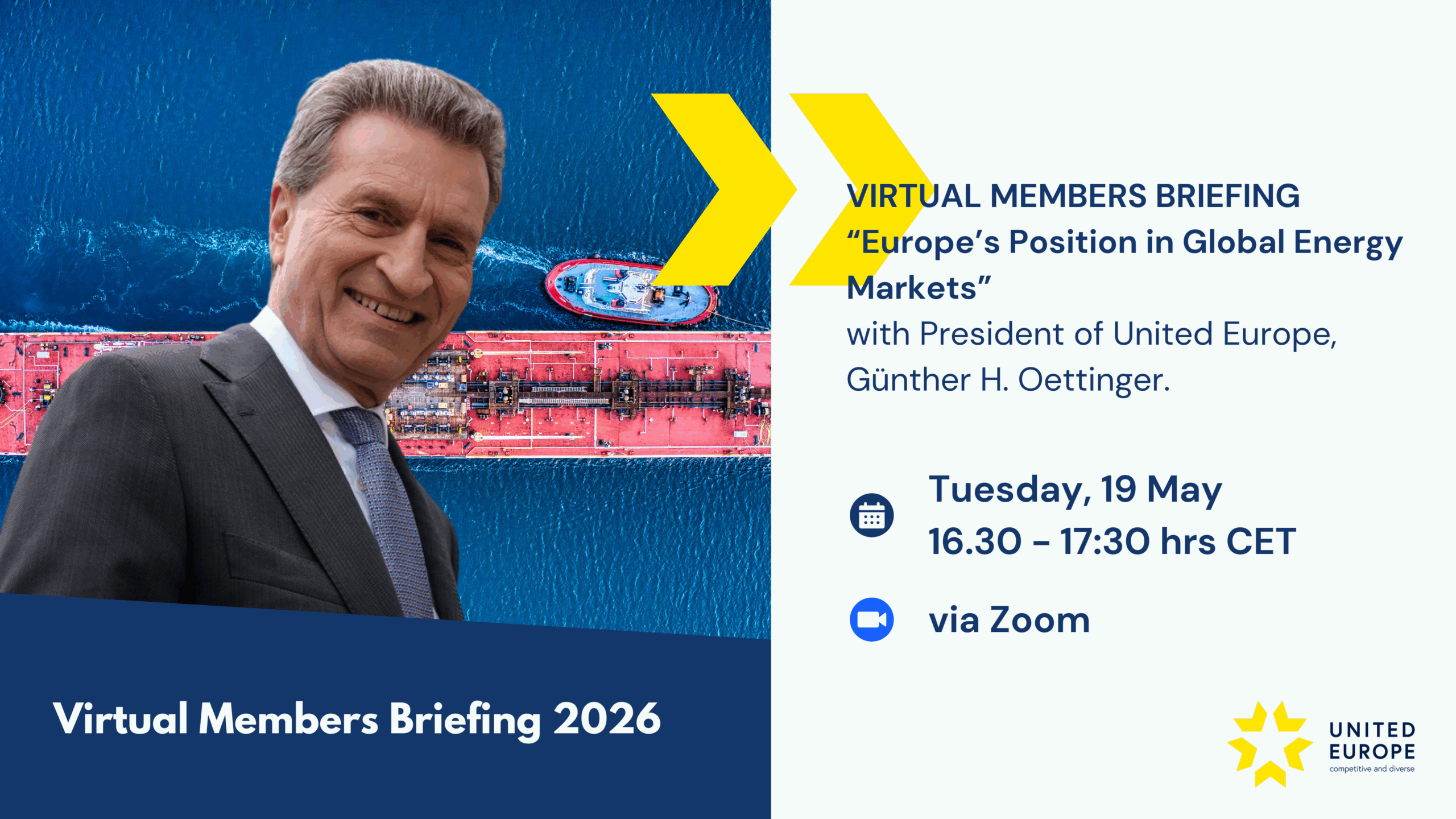
At United Europe’s recent virtual members’ briefing, Günther H. Oettinger set the tone with a candid assessment of Europe’s current energy debate, calling for greater realism and pragmatism in energy policy: “We need a more realistic and pragmatic approach!” Even if geopolitical tensions were to ease tomorrow, he stressed that energy markets would not simply return to normal within weeks. Imports, supply chains, and global energy flows remain deeply uncertain, and Europe continues to face major vulnerabilities regarding security of supply.
His central criticism focused on the imbalance in Europe’s energy policy over recent years. While the Green Deal became the dominant political priority, affordability and security of supply were increasingly sidelined. This imbalance has weakened Europe’s competitiveness and exposed dangerous strategic dependencies. He called for the return to a genuine “energy triangle” where sustainability, affordability, and security are treated equally rather than ideologically ranked.
Günther H. Oettinger also emphasized that Europe’s future energy demand will increase dramatically. Electrification, electric mobility, AI, cloud services, giga factories, data centers, and industrial transformation will all require significantly more electricity than today. He argued that Europe urgently needs a coordinated infrastructure strategy – from super grids and pipelines to hydrogen corridors and storage capacity – instead of fragmented national approaches.
Another major point Oettinger has raised was the need for technological realism. He criticized ideological blind spots in Europe’s energy debate. Oil, gas, LNG, hydrogen, renewables, nuclear power, and future technologies such as fusion should all remain part of the discussion. Oettinger described diversification repeatedly as essential not only in terms of suppliers, but also technologies and infrastructure.
The debate around nuclear power illustrated Europe’s divisions particularly clearly. While some members states strongly opposed, many others continue to invest heavily in nuclear energy and fusion research. Can Europe afford to ignore such technologies while global competitors continue advancing rapidly?
FAZIT: Europe needs to move away from energy policy shaped by idealism and ideology and return to a more pragmatic, strategic, and competitive approach focused on resilience, diversification, and industrial strength.
Members Interventions:
The members interventions reflected both frustration and concern about Europe’s current trajectory. Several members argued that the EU’s regulatory approach often fails to reflect economic and industrial realities. While derivatives and targets are designed around decarbonization and efficiency, participants questioned whether they sufficiently account for the enormous future energy needs created by AI, data centers, electrification, and industrial production.
A recurring criticism was that Europe increasingly risks undermining its own industrial base. Members pointed to growing energy price disadvantages compared to the United States and China and warned that companies are already relocating production outside Europe. BASF, Covestro, Bayer, and other industrial players were repeatedly mentioned as examples of this trend. Some participants argued that Europe is slowly “regulating itself out of competitiveness.”
At the same time, members emphasized that the debate should not become a simplistic choice between climate protection and competitiveness. The example of BASF’s operations in China – powered largely through renewable electricity – was raised to show that industrial competitiveness and clean energy are not mutually exclusive if infrastructure and investment conditions are right. The real issue. Participants argued, is whether Europe is creating the conditions necessary to scale such models itself.
The nuclear debate triggered particularly sharp interventions. Several participants pointed out what they viewed as contradictions in the German debate: while Germany phased out nuclear energy domestically, neighboring countries continue building reactors and exporting nuclear energy already – only indirectly and at the cost of strategic inconsistency.
There was also frustration over Europe’s inability to scale innovation. Participants highlighted cases where technologies developed in Europe were commercialized elsewhere, particularly in China or the United States. Questions were raised about why Europe is hesitant to invest boldly in fusion, AI, quantum technologies, and large-scale industrial infrastructure while competitors move ahead more decisively.
Members also warned that Europe may underestimate the urgency of the current situation. Concerns were expressed about industrial decline, job losses, supply vulnerabilities, and the risk of another severe energy crisis. Several participants argued that Europe continues to react too slowly while competitors act with far greater strategic clarity.