
Working Group:
A Rebalanced Energy Triangle: Secure, Sustainable, and Affordable Energy Future
Europa steht vor einer Häufung geopolitischer Schocks, wirtschaftlicher Belastungen und struktureller Verwundbarkeiten, die seine Wettbewerbsfähigkeit und strategische Autonomie bedrohen. In einer fragmentierten und multipolaren Welt verliert die Europäische Union an Einfluss und muss entschlossen handeln, um mehr Geschlossenheit zu erreichen und ihre Relevanz zurückzugewinnen.
Hohe Inflation, angespannte öffentliche Haushalte und dauerhaft erhöhte Energiepreise schwächen die industrielle Stärke und die soziale Stabilität. Um diese Herausforderungen erfolgreich zu bewältigen, muss Europa seine Energiepolitik stärker europäisieren und gleichzeitig das Subsidiaritätsprinzip respektieren – mit dem Ziel, die drei Dimensionen des Energie-Trilemmas ins Gleichgewicht zu bringen: Versorgungssicherheit, Nachhaltigkeit und Bezahlbarkeit.
Nationale Strategien müssen sich stärker an gemeinsamen europäischen Zielen orientieren und grenzüberschreitende Zusammenarbeit sowie den Ausbau strategischer Infrastruktur priorisieren. Fragmentierung, regulatorische Übersteuerung und zögerliche Umsetzung haben Europa verwundbar gemacht – insbesondere bei der Energieversorgung, bei Rohstoffen und in Schlüsseltechnologien. Mit nur rund 9 % der Weltbevölkerung kann Europa sich weder Abschottung noch langwierige Grundsatzdebatten leisten.
Eine vereinte, pragmatische und zukunftsorientierte Strategie ist daher unverzichtbar. Die Lösung des Energie-Trilemmas erfordert eine klare Vision und eine schnelle, zugleich anpassungsfähige Governance. Europa braucht einen entschiedenen Kurswechsel weg von der Fixierung auf starre Prozentziele, aus denen nachträglich Maßnahmen abgeleitet werden, die teilweise mehr schaden als nützen – hin zu lösungsorientiertem Denken und praktischer Umsetzbarkeit.
Fast aus Selbstschutz und angesichts der drohenden Deindustrialisierung fordert die Industrie kurzfristige Entlastungen wie einen temporären industriellen Strompreis. Das ist nachvollziehbar, wirkt aber nur wie ein Pflaster und verdeckt strukturelle Schwächen. Solche Maßnahmen verzerren Preissignale und bergen das Risiko, dass Europa in eine Spirale immer weiter eskalierender Subventionssysteme gerät. Ohne strukturelle Reformen werden die Kosten weiter steigen und die Wettbewerbsfähigkeit weiter erodieren.
Europa muss jetzt handeln – gemeinsam, pragmatisch und mit unerschütterlichem Fokus auf Umsetzung.
Vorsitz

Chair:
Burkhard von Kienitz
COO Processes at EON
Teilnehmer

Dyria Sigrid Alloussi
United Europe

Edon Babameto
ESMT

Frank Düssler
GMH Gruppe

Manuel Fröling

Dennis Rendschmidt
VDMA

Felix Klein
Young Leader at United Europe e.V.

Sebastian Grub
Drees & Sommer

Benedikt Rothhagen
VDMA

Arslan Suleymanov
Visegrad Insights

Sofia Trojanowska
Infosys
Chapter 1 – Energy Security
Executive Summary:
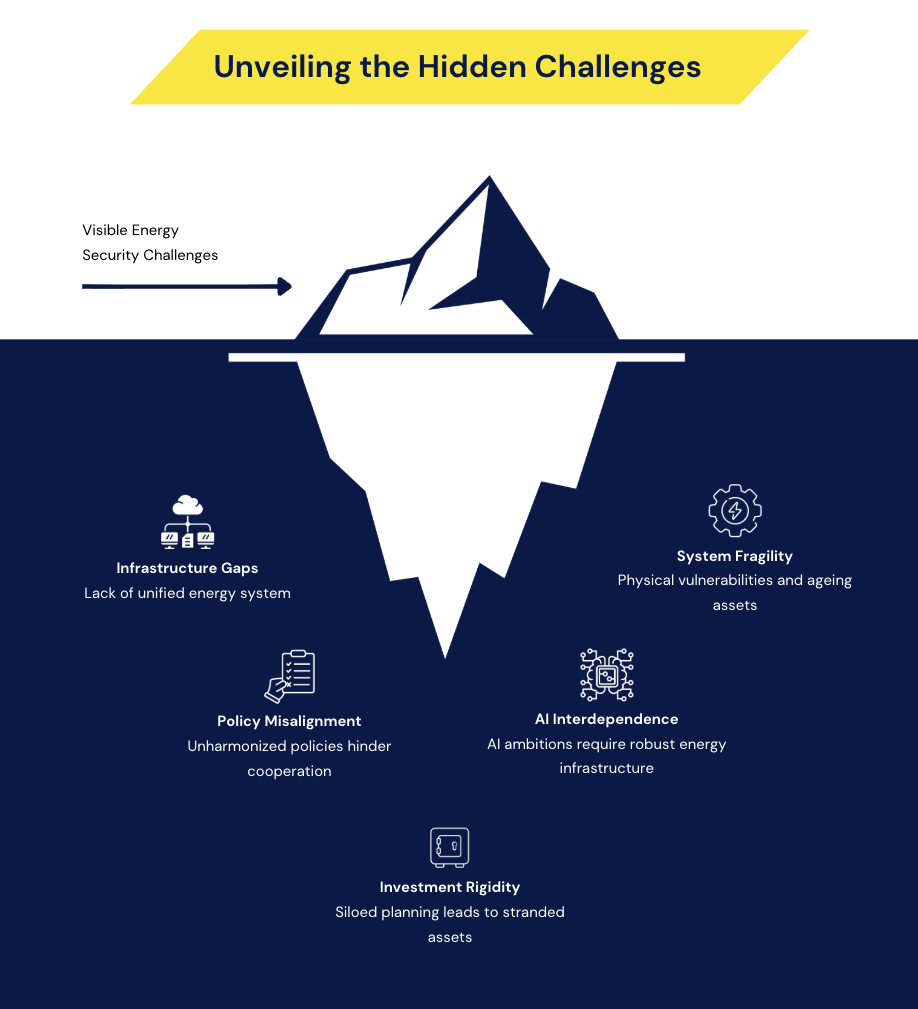
Energy systems are an essential part of Europe’s critical infrastructure and must therefore be made more strategically interconnected, secure, stable, and resilient. Fragmented national systems, underinvestment, and misaligned policies leave the continent vulnerable to blackouts, stranded assets, and geopolitical risk. Supply chains of energy and AI hardware must be diversified and be based on reliable partners. Inner-European supply chains enhance security, resilience, and European employment. We focus on five key challenges:
1.1 Shared Coordination instead of Fragmentation & Infrastructure Gaps
Europe still lacks a unified energy system. National systems differ in technical standards and capabilities. Many DSOs cannot yet handle higher shares of volatile renewable energy flows or bi-directional electricity from Distributed Energy Resources. Interconnections remain insufficient, especially in southern and eastern Europe, limiting resilience and renewable integration.
1.2 System Fragility & Physical Risks
Incidents like the April 2025 Iberian blackout and Estlink-2 cable damage reveal physical vulnerabilities, ageing assets, and sabotage risks. Embedding resilience and redundancy in planning is crucial. Renewing infrastructure offers an opportunity to introduce shared standards and deepen interconnection, improving Europe’s ability to balance power flows.
1.3 Policy Alignment & Reduction of Regulatory Barriers
Unharmonized national policies and slow permitting hinder cross-border cooperation and slow the deployment of flexibility assets, smart grids, and distributed energy resources.
1.4 AI Infrastructure & Strategic Interdependence
Europe’s ambition to lead in AI (e.g., AI Continent Plan, EuroHPC, GenAI4EU, and Special Compute Zones) requires a significantly higher level of energy infrastructure, power security, cooling, hydrogen, and data-flow integration. Data centres are set to triple capacity by 2030.
1.5 Investment Rigidity & Stranded Asset Risks
Large infrastructure projects take 5–10 years from concept to commissioning. A lack of foresight and siloed planning can lock in outdated technologies and lead to stranded assets, wasting public and private capital.
1.6 Call to Action:
To guarantee and enhance energy security, Europe must:
-
Establish a European Infrastructure & Interconnection Masterplan
by replacing fragmented national systems with a unified EU masterplan integrating power, hydrogen, and digital networks. -
Embed Resilience & Redundancy as Core Planning Principles
by explicitly engineering resilience into every new project. Redundancy, recovery capability, and resilience audits must be embedded into all major infrastructure investments. Energy and data systems should be better acknowledged as critical infrastructure eligible for emergency permitting and enhanced protection. -
Align Regulatory Frameworks & Accelerate Permitting
Europe needs coherent, streamlined regulation to speed up cross-border infrastructure and lower transaction costs. A one-stop EU Permitting Platform linking national authorities with unified timelines and mutual recognition of permits can significantly accelerate deployment. -
Integrate AI Infrastructure into Energy System Planning
to ensure AI factories and data centres use energy efficiently and are fully embedded in energy-system design to guarantee predictable, low-carbon power and system stability. -
Secure Strategic Autonomy through Resource & Supply-Chain Sovereignty
by strengthening control over critical materials, components, and manufacturing to ensure resilience and reduce dependency on vulnerable supply chains. Strategic raw-material projects should be fast-tracked, EU-based component manufacturing supported, and trusted-partner procurement prioritised.
Europe’s energy security requires 5 pillars to be unveiled and enabled.
Chapter 2 – Sustainability, Competitiveness & Trade Resilience
Executive Summary:
Decisive factors such as supply security, access to raw materials, and the preservation of industrial value creation are regrettably neglected by policymakers in the current energy transition strategy. What is required is a realistic, technology-open, and stable pathway that aligns ecological objectives with economic strength and social cohesion. The current binding requirements for the detailed implementation of specified reduction approaches should be replaced by more individual freedom of design that enables innovation and creativity.
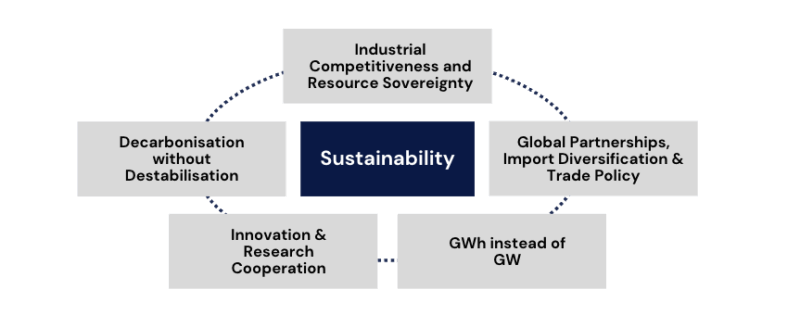
2.1 Decarbonisation without Destabilisation
The transition to a climate-neutral economy demands accelerated emissions reduction of greenhouse gases, but must not undermine system stability. Europe should avoid enacting rubber-stamp policies that mimic electoral cycles or geopolitical flashpoints, and prioritise meritocratic, long-term policymaking.
The practice of ‘colouring molecules’ – assigning color codes to energy carriers (like hydrogen) based on their production method – is a purely bureaucratic micromanagement procedure that hinders the ramp-up of industrial production, obscures the actual emissions associated with producing a given hydrogen, and complicates trade. We didn’t do it with electrons, and we shouldn’t do it with molecules either.
Commission Delegated Regulation (EU) 2023/1184, as well as other labelling requirements established under the Renewable Energy Directive (II) (RED II) are excessive and are preventing the ramp-up of renewable energy production.
2.2 Industrial Competitiveness and Resource Sovereignty
A robust, comprehensive energy industrial policy that strengthens the whole value chain is necessary. Such policy should empower member-states to explore and develop European raw material reserves and processing capacities for rare earth elements on par with renewable energy sources. In turn, this would also increase the Union’s overall industrial competitiveness vis-à-vis the United States and China, enabling Europe to secure more beneficial and resilient partnerships. Decarbonisation must also remain compatible with competitive energy prices, which is possible through diversification. All clean energy sources – from renewables, nuclear, and hydrogen to carbon capture – must remain on the table.
2.3 Global Partnerships, Import Diversification & Trade Policy
Energy supply diversification should be pursued actively – and continually – with partners that have abundant resources, know-how, and infrastructure. Physical protection of supply chain infrastructure and disaster response strategies should be taken into account.
2.4 Innovation & Research Cooperation
Stronger coordination between European initiatives such as Horizon Europe, SET, and the EERA is essential to focus resources on breakthrough decarbonisation technologies, on par with long-term, predictable funding.
2.5. GWh instead of GW
Renewables must prove themselves in the market. Instead of paying subsidies in nonsensical locations, system integration and system utility must be considered from the beginning. Regulation must be corrected where it leads to inappropriate solutions. If batteries are exempted from fees and thus subsidized because of their potential grid serviceability, this benefit and control by the grid and integration into the system must be the condition—not purely financial advantages.
2.6 Call to Action
To reconcile sustainability with competitiveness, Europe must:
- Define a realistic and holistic decarbonisation pathway that integrates climate ambition with energy security and competitiveness. Focus on measures that truly and quickly help the climate rather than on back-casting.
- Secure resource sovereignty and achieve the goals of the Critical Raw Materials Act through domestic exploration and partnerships within existing and proposed initiatives, such as Projects of Common Interest (PCIs), Connecting Europe Facility, as well as the Strategic Roadmap for Digitalisation and AI in Energy.
- Deepen global partnerships to ensure access to energy, raw materials, and technologies, including through increased investments abroad within the Global Gateway initiative, the Joint Declaration of Intent on Critical Raw Materials between the EU and Central Asia, the Africa-EU Energy Partnership as well as other, bilateral agreements.
- Institutionalise technological openness preserving optionality across renewables, nuclear, hydrogen, CCS and digital solutions.
- Strengthen innovation ecosystems by accelerating research-to-deployment pipelines and scaling industrial capacity.
Chapter 3 – Affordability
Europe’s energy transition is a climate imperative and an investment challenge of historic scale, requiring hundreds of billions of euros in new capital. The key task is to keep the transition affordable, socially balanced, and politically feasible. Unrealistic targets and fragmented regulation risk raising costs and slowing deployment.
A pragmatic, Europe-focused policy framework—built on coherent market design, faster permitting, and deeper financial integration—can lower system costs while accelerating progress. To mobilize private capital at scale, the EU must provide long-term regulatory certainty and reduce friction across borders. Ultimately, the transition will only succeed if it produces viable business models that make clean energy not just sustainable, but economically competitive and investable.
- Affordability & a Competitive Energy Transition
To achieve this, a successful energy transition must rest on a strong and competitive European economy with clear and predictable long-term policy. For this reason, the EU and its member states must establish more supportive and predictable framework conditions. - Structural Barriers
Achieving affordability requires addressing structural barriers, particularly by better integrating the 27 national energy grids. This integration is crucial for reducing costs, optimising resources, and enhancing system resilience. The replacement of fossil fuels with renewable electricity must be advanced in a way that strengthens the grid, supported by a simultaneous and large-scale expansion of infrastructure and comprehensive flexibility measures across the energy system. Equally important are technological openness and fair competition, which are vital for driving efficiency and innovation. Sector coupling, diversified supply chains, and key innovations such as hydrogen, Carbon Capture and Storage (CCS), and digital solutions are essential elements for constructing an affordable and future-proof energy system. - Financing of the Energy Transition
Europe’s energy transition requires massive investment at a time when public budgets are strained. Mobilising private capital is therefore essential, making the long-delayed Capital Markets Union (CMU) a critical enabler. By harmonizing tax, insolvency, and reporting rules, the CMU can lower transaction costs, improve predictability, and broaden access to financing — unlocking capital at scale while keeping projects attractive for investors and affordable for consumers.
Efficient capital markets must remain the backbone of the transition. Excessive subsidies risk distorting price signals, creating overcapacity, and undermining Europe’s competitiveness. In a rapidly evolving environment of volatile markets and fast technological progress, policy should be guided by real-time developments rather than outdated projections or politically predetermined targets. The EU should therefore replace static forecasts with a dynamic, evidence-based mechanism for assessing demand and infrastructure needs.
At the same time, new infrastructure — such as for hydrogen — often requires upfront investment under conditions of uncertainty. Here, the EU and its member states should take decisive measures in order to lift new technologies off the ground and establish technological leadership in key areas. - Regulatory Barriers
Finally, excessive regulation and bureaucratic delays remain major obstacles to achieving an affordable and efficient energy transition. Despite progress, faster action is urgently needed. Streamlined permitting and coordinated approvals — like COVID-19 emergency measures or fast-track LNG terminal construction in Germany — could lower costs and reduce investor risks from delays. Standardised tax credits and streamlined permitting to provide rapid investment certainty, e.g. as provided through the U.S. Inflation Reduction Act, can be powerful tools as well.
Call to Action
To achieve an affordable and fair energy transition, Europe must:
-
Commit to a pragmatic, predictable, and economically grounded transition strategy that accelerates climate action while keeping costs manageable for citizens and businesses.
-
Prioritise full grid integration, rapid infrastructure expansion, and technology-neutral innovation policies to build a resilient, flexible, and affordable energy system.
-
Accelerate completion of the Capital Markets Union and expand public-private investment tools to unlock private capital at scale while preserving market-driven efficiency.
-
Implement a dynamic, evidence-based monitoring framework that regularly assesses real energy demand and infrastructure needs, reduces reliance on costly subsidies, and ensures policies remain efficient, market-driven, and aligned with economic and technological realities.
-
Streamline permitting, cut unnecessary bureaucracy, and establish stable long-term rules to restore investor confidence and fast-track an affordable, competitive transition.
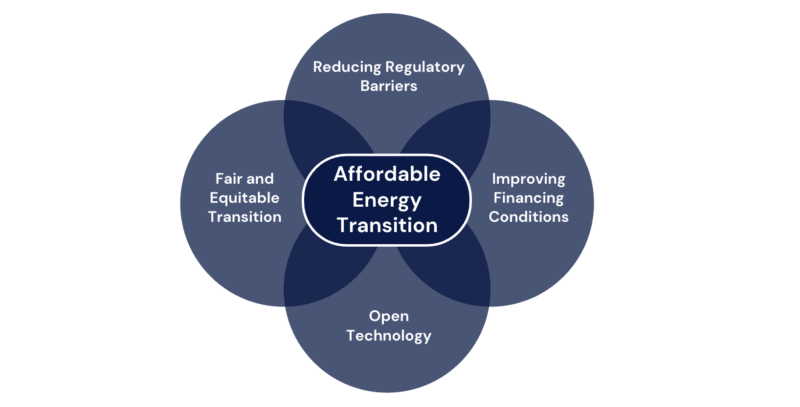
Overlapping priorities for an affordable European Energy Transition:
-
Reducing Regulatory Barriers
-
Improving Financing Conditions
-
Open Technology
-
Fair and Equitable Transition
-
Affordable Energy Transition