

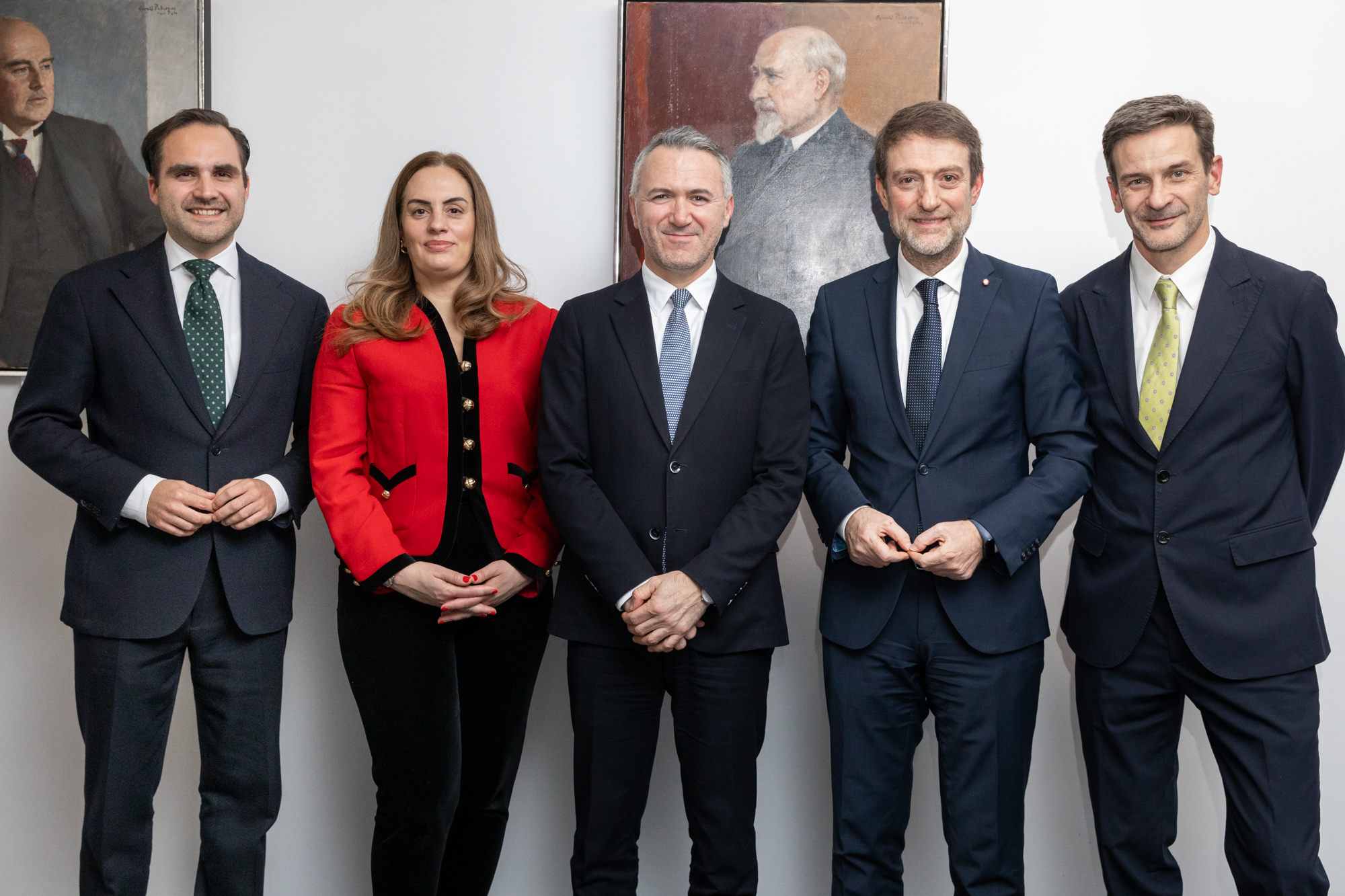
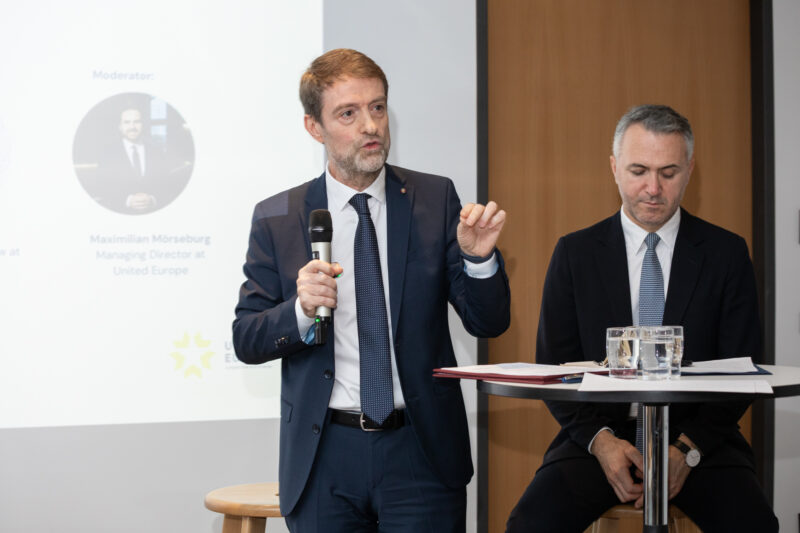
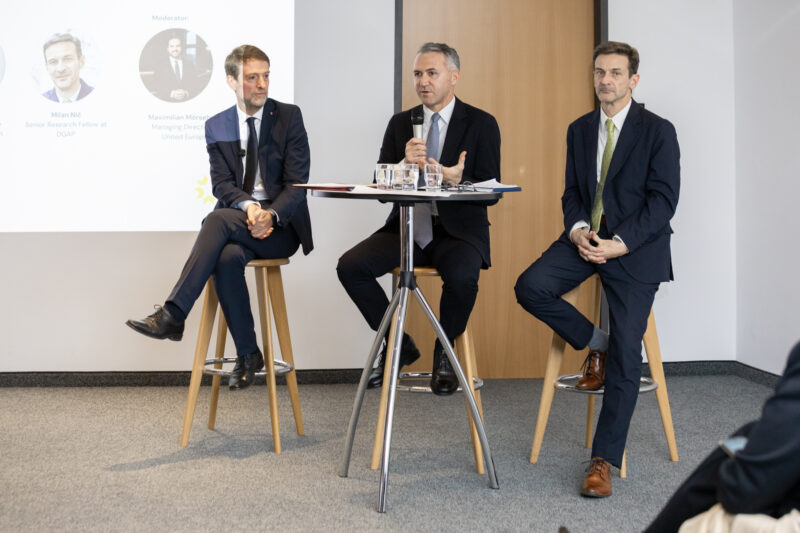
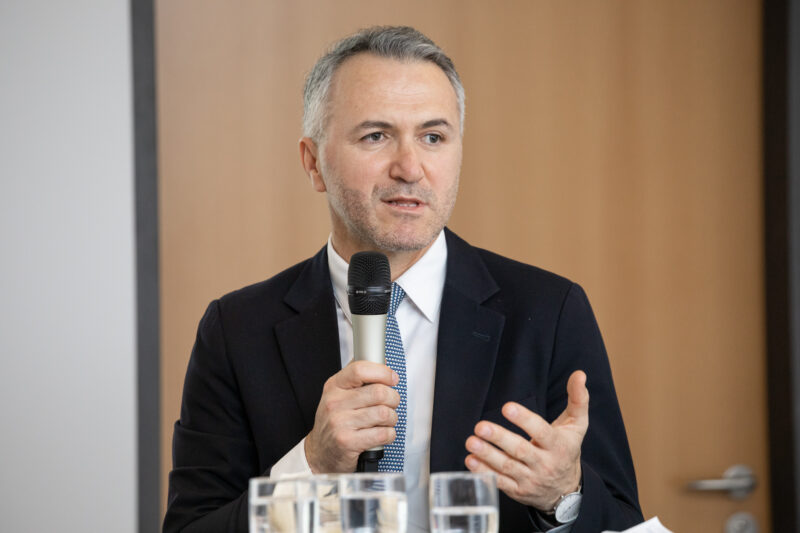
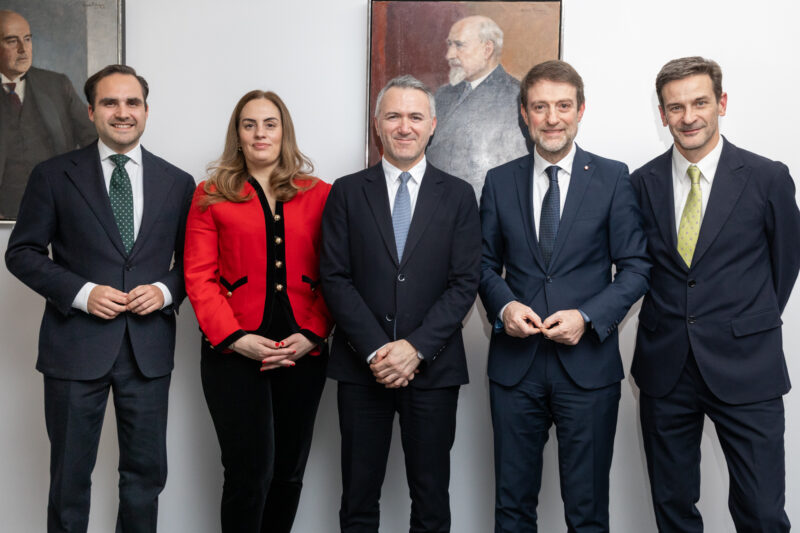
Highlights from the United Europe Panel Discussion (held under Chatham House Rule) on 3rd November 2026 with Gunther Krichbaum (Stateminister for Europe), Ferit Hoxha (Foreign Minister of Albania), Jeton Zulfaj (Chief Negotiator for Kosovo with the European Union) and Milan Nic, Senior Fellow at the DGAP. The discussion was moderated by Maximilian Mörseburg.
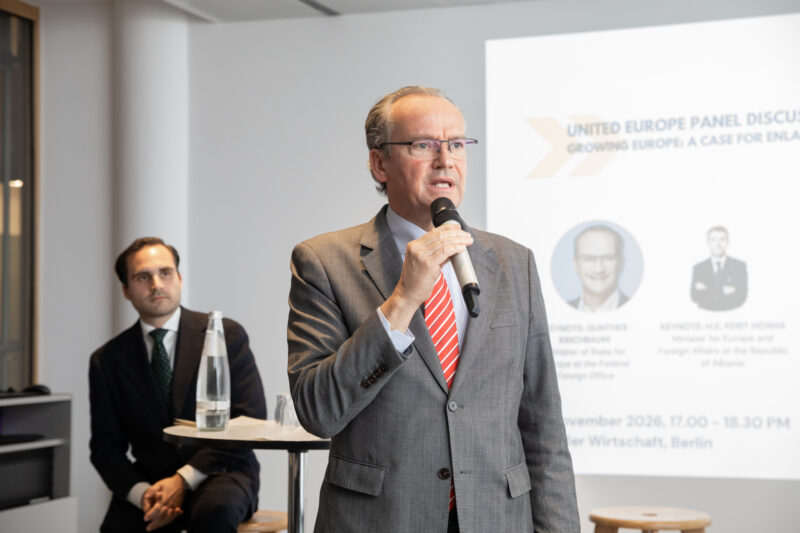
The timing could hardly have been better. The European Commission is preparing to discuss its annual enlargement package, the progress reports on every candidate country, and Euronews is holding its own Enlargement Summit in Brussels. Against this backdrop, United Europe brought policymakers, diplomats and experts together for our annual Enlargement Summit. The message was clear: the moment for enlargement is now. Europe cannot afford to wait for the next decade.
A stronger Europe is a necessity
Look at the world around us: Russia’s war of aggression against Ukraine, an assertive China, a United States with an erratic leadership whose direction is uncertain. All of it points to one conclusion. Europe needs to be stronger. Yet at home the picture is fragile. Spain faces elections with an open outcome. Bulgaria and Romania face political uncertainty. France votes in spring 2027. Poland is in a dispute over its highest court, and Germany has a weak government. A democratic continent needs strong governance in its Member States and efficiency and unity at European level.
Remembering where we came from
Europe began as an act of courage. In 1950, Robert Schumann and Jean Monnet proposed pooling coal and steel. Only five years after the Second World War, Germany has been invited to become a founding member alongside France, Italy, Belgium, the Netherlands and Luxembourg. That integration helped make the German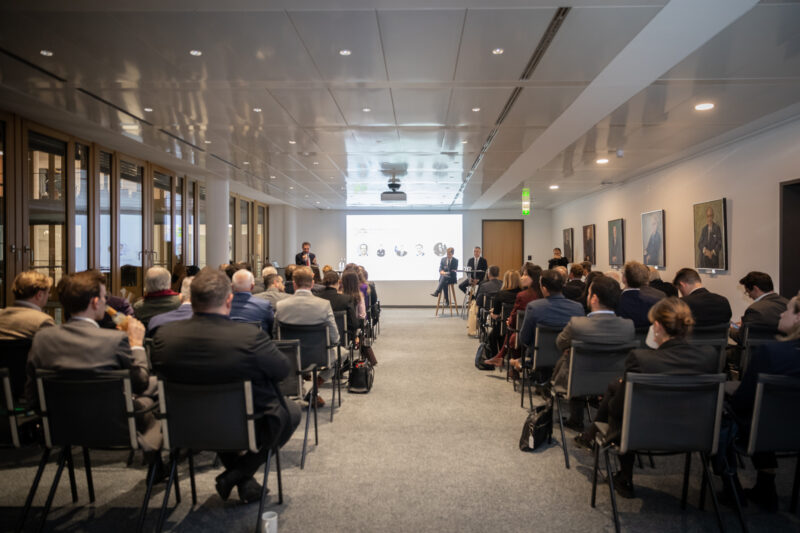 Wirtschaftwunder possible.
The audience was reminded how much trust France needed to reach out to Germany after all the atrocities committed in Germany’s name. From six founding members the Community grew into the European Union, reaching 28 members and 27 today. Every step took ambition: Schuman and Monnet, later Chirac and Kohl with the single currency. It was done, and it was right.
Courage was the message of the day. It is the same courage Europe needs today when it talks about enlargement.
Export stability or import instability
One argument ran through the discussion: Europe can either export stability or import instability. Enlargement is in our own geostrategic interest.
The Western Balkans are now the key. Albania, North Macedonia, Serbia, Bosnia and Herzegovina, Montenegro and Kosovo from a region already surrounded by EU members. Moldova, and Ukraine are also candidates and Europe’s wider neighbourhood includes close partners such as Switzerland, Norway and the UK.
The Commission has already done a great deal, especially on energy. It is linking the Western Balkans to the European grid, through pipelines, and through shared rules and standards. One speaker drew a comparison: Germany integrated and co-financed 16 million citizens from the East after reunification. A Union of some 450 million people can surely integrate the roughly 18 million people of the Western Balkans. Corruptions exists in Germany and elsewhere too, so Europe should not be so arrogant and claim the time is not right.
From a high jump to a staircase
Are we prepared for enlargement? The honest answer was no, not with today’s methods. We are no longer in the 2000s, when ten countries joined in 2004 and Romania and Bulgaria followed in 2007. Croatia, the last country to join, negotiated for more than eight years. Other candidates have waited far longer. Their citizens increasingly feel forgotten, and enlargement policy is suffering a crisis of credibility.
The proposed answer is gradual integration. Today accession works like a high-jump competition, and the bar keeps rising. Earlier entrants faced lower hurdles, because EU standards on environmental and consumer protection, among others, have become ever more demanding. Instead, accession should be a staircase, climbed step by step. Each step should bring added value that ordinary people can see and feel.
Once a country meets certain criteria, its status should change. Observer status in the European Council or the European Parliament would not cost a single cent. It would send a clear signal to the candidates and to Europe’s adversaries alike, that these countries belong to the European family. An associated status must make clear that the final destination is full membership.
Participants also argued for opening all negotiating clusters with Ukraine and Moldova and others forward. Urgency matters, Elections in 2027 could bring unwanted outcomes, and Europe must plan for the worst case, including a stronger far-right presence in European Parliament during negotiations on the next Multiannual Financial Framework (MFF). Some candidates are already better prepared in certain areas than existing Member States. For them, accession is a litmus test of whether the EU keeps its word.
Perspectives from the candidate countries
Speakers from the region said the accession process is delivering real change in their respective countries. One candidate is opening and closing chapters, and has never transformed more than during accession. Its ambition has not changed, but the world around it has. Windows for enlargement do not stay open forever, and membership is earned benchmark by benchmark, together with citizens. At the end of the road, they said, there must be a real door.
Kosovo’s situation got particular attention. It has had a European perspective since the 2003 Thessaloniki summit, and public support for the EU there is among the highest in the region. It has made progress on the rule of law, fighting corruption and crime, and economic growth of around 4%, yet it still lacks candidate status. Germany is Kosovo’s closest development partner and main EU trading partner, with more than €700 million invested. Close to €3.7billion of EU money has supported democracy, rule of law and fundamental rights there. After all that investment, opening accession talks was described as the natural next chapter.
Make of break: the next six months
Speakers warned that the coming months are make or break. Montenegro is close to finishing accession talks, largely without public attention. If it gets past the point of no return before the French elections, it could break the glass ceiling for everyone. Moldova, Kosovo and Ukraine are also at crucial oints and their paths are linked. Europe must be ready to offer Ukraine something concrete once peace talks begin. That is not a competition with the Western Balkans: everyone is in the same boat.
The stakes are high. No new member has joined in 13 years, and the Western Balkans were promised a European future 23 years ago, a whole generation. If the EU cannot keep its closest partners in the Balkans, how can it expect to succeed in Latin America or Africa? And who will believe politicians campaigning under the European flag if nothing ever happens?
There was also a reminder of what enlargement means for peace. With Montenegro, EU would for the first time admit a country that fought against a current Member State some 35 years ago, when Dubrovnik was shelled. Enlargement is a peace project between Montenegro and Croatia, and hopefully one day for Kosovo too. At a time when Europe is taken seriously in Washington, moving forward on enlargement could lay the foundations for a new European security architecture.
Conclusion:
Europe was born of courage and trust. Through its reforms and the candidates’s reforms, Europe can finally become one full and complete family. That is the case for enlargement, and the time to make it is now.