


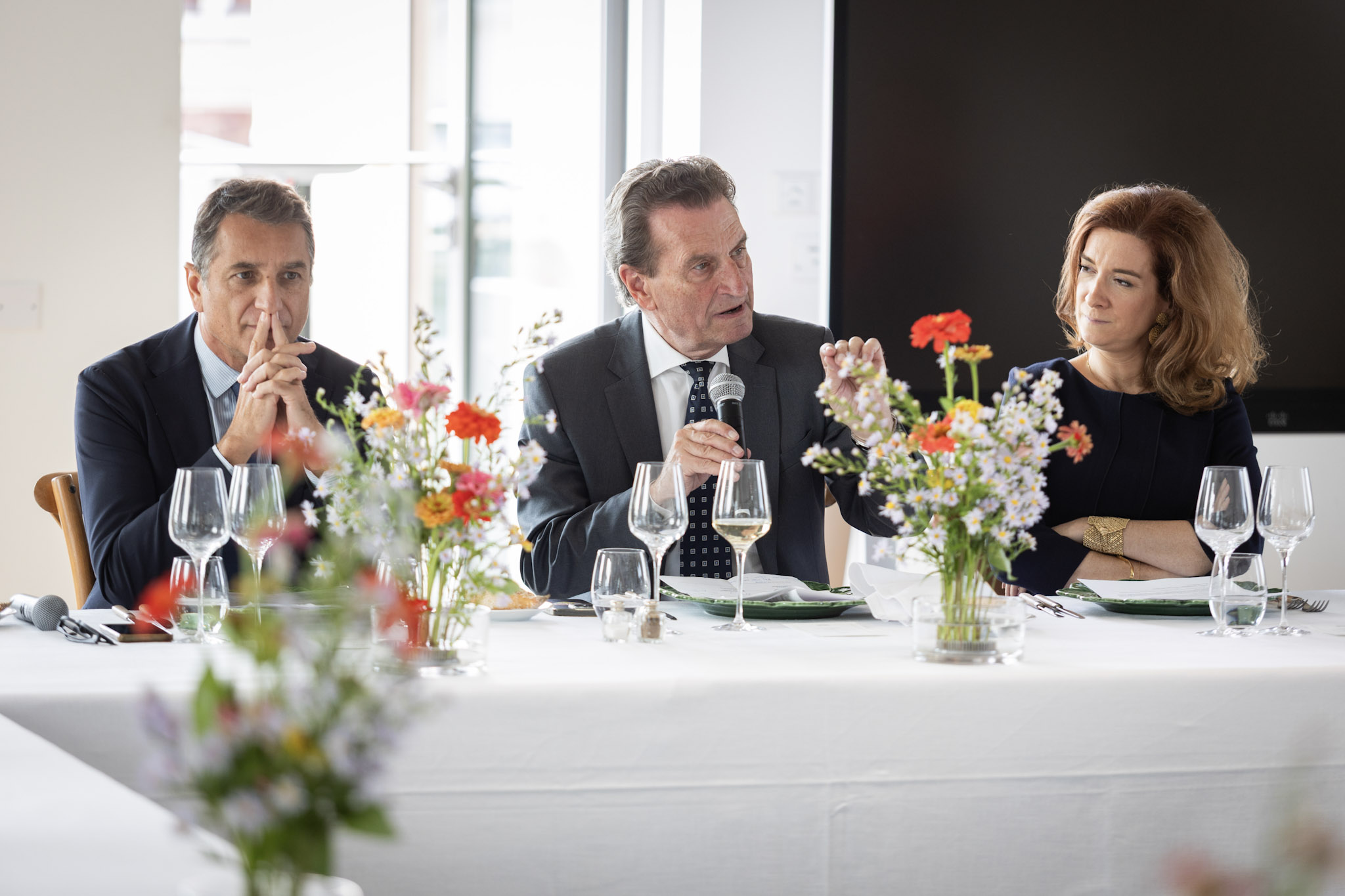
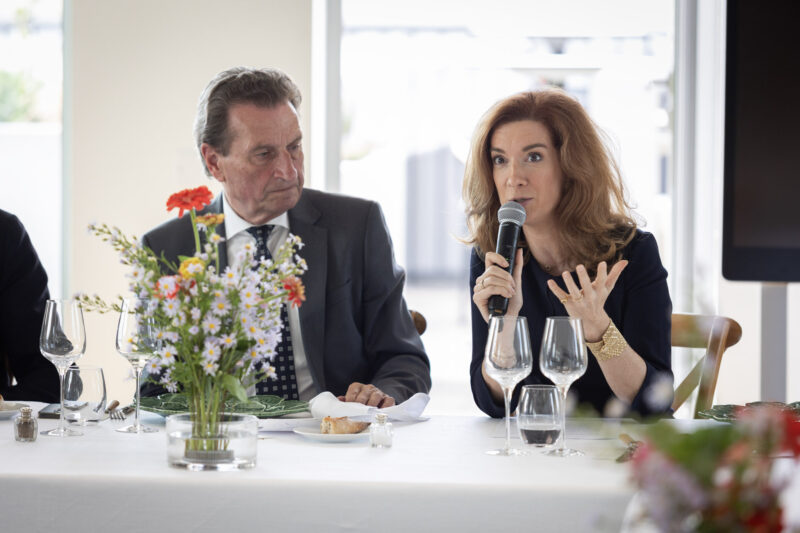
On 6 December, investors, entrepreneurs and policy experts from France and Germany met in Paris for the CEO French-German Dialogue hosted in partnership with Eurazeo. The question on the table was: How can Europe restore its competitiveness, strengthen its economic growth, and secure its strategic position in an increasingly complex global environment?
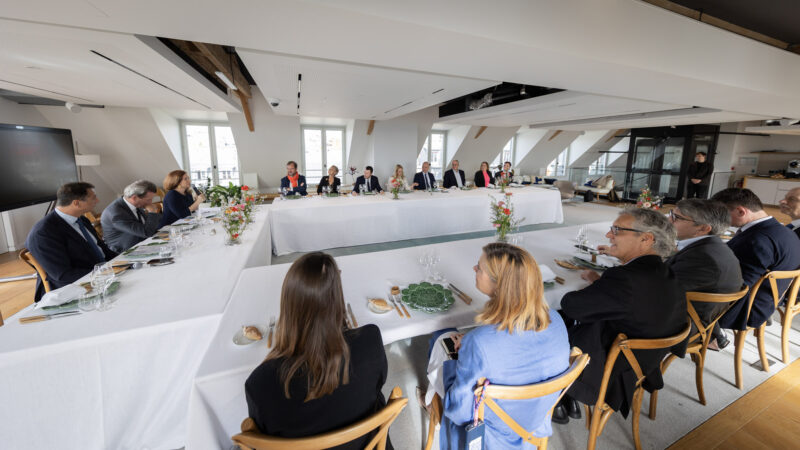 The discussion was held under Chatham House Rule. What follows reflects the ideas exchanged in the room. The mood swung between alarm and quiet confidence. That tension turned out to be the most honest picture of where Europe stands today.
Günther H. Oettinger opened the dialogue with a sobering diagnosis without diplomatic paddling. The US still holds about 25% of global GDP, despite the rise of India, Malaysia, and Brazil. Europe’s share has fallen from 28% to 17%. China has climbed from 7% to 17%.
Growth tells the same story. Germany ist stagnating and France grows only slightly, while the US holds steady at around 2.5%, China at 4-5% and India at 6-7%. Europe faces the prospect of roughly seven years of low growth, stagnation or even recession.
Sector by sector, the picture is mixed:
– Strong: aerospace (Airbus), chemicals and pharmaceuticals
– Falling behind: digital and increasingly automotive
What is missing from the agenda is a coherent US and China strategy and therefore Europe risks becoming “the loser of the century” caught in a sandwich between Washington and Beijing. The way out, it was argued, rests on tackling two priorities – security and competitiveness – and overcoming two challenges: governance and debt.
PRIORITY ONE: SECURITY
Security – external, internal, cyber – was named the first priority. One question landed hard in the room: why do 550 million Europeans (including UK and Ukraine) need 350 million Americans to defend them against 150 million Russians? The answer offered was that Europe must do far more to protect its continent, its peace and its values – “for us, for our children and for our common democratic future.”
PRIORITY TWO: COMPETITIVENESS
Escaping the sandwich requires “new Airbus ideas”, and France and Germany are key to them. Speakers called for completing the single market and finally acting on the Draghi and Letta reports. The market, they stressed, is global – not French, German or even European – so Europe needs players that can compete globally.
That means overcoming old reflexes. Germany opposed TTIP; France opposed Mercosur. Instead, the EU – itself a group of middle powers – could build alliances with Canada, Australia, Japan, South Korea, Brazil, the Emirates and Saudia Arabia, through trade agreements and joint research such as Horizon Europe.
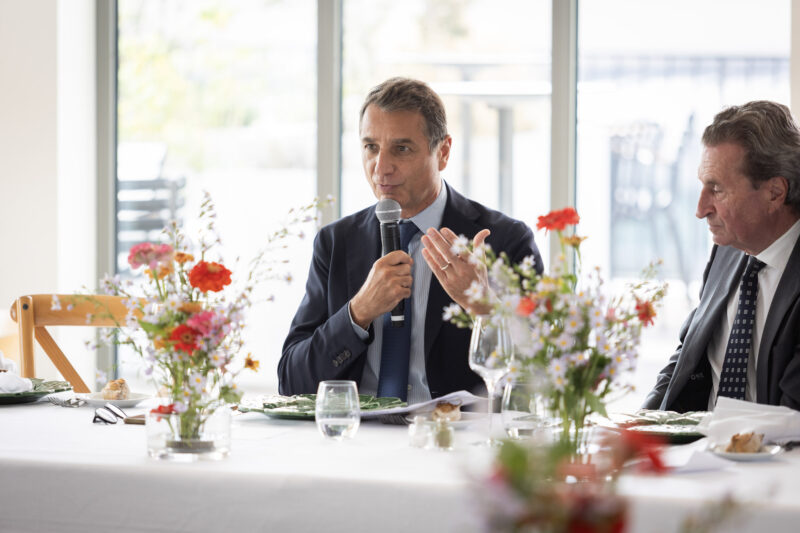 Not everyone shared the gloom. William Kaddouch-Chassaing, Co-CEO at Eurazeo argued that Europe is still winning in important ways:
– Europe trains more engineers each year than any other continent
– Its universities, infrastructure and social stability increasingly attract capital from Asia, the Middle East and even the US
– Investors see US growth and the dollar as highly volatile and value Europe’s stability.
Kaddouch-Chassaing summed up the investors perspective neatly: they dislike Europe’s sluggish macro picture but love its micro picture. MedTech (about 40% in the world is German), biotech, healthcare, water and clean tech all generate strong returns. Even in AI, Mistral shows a European LLM provider can scale, drawing on French, German, Dutch and UK talent – though computing capacity remains indeed far behind.
He praised concrete steps: the “EU Inc” or 28th regime for company law, the push towards a Savings and Investment Union, securitisation, market infrastructure and pension reform. But he also warned that Europe remains astonishingly naive about China’s push into its manufacturing base.
 ENERGY: TRADING ONE DEPENDENCY FOR ANOTHER
For Anne-Laure De Chammard, Energy prices are central to competitiveness, and Europe remains far too dependent on outside powers. After years of naive reliance on Russian gas, 50-60% of supply has shifted to the US – once dependency swapped for another. The crisis around the Strait of Hormuz has exposed this weakness again. The answer, De Chammard argued, is to move from “imported molecules” to “home-grown electrons”. Europe is doing this but around 2,000 GW of renewable projects are stuck because there are no grids to carry the power to where it is needed. With 27 countries and 27 sets of rules and specifications, Europe cannot scale or secure its supply. A common approach to grids is the bare minimum.
New dependencies are already forming:
– Solar and wind: largely supplied by China – if deliveries stopped, Europe’s lights would go out.
– Critical minerals and lithium batteries: also mainly Chinese
– Software and data: about 70% of EU data sits with US hyperscalers, which effectively control it.
– Turbines: flowing to the US to power its data centre boom, leaving too few for Europe.
The message: without European champions – and the mergers and acquisitions needed to build them – Europe stands no chance on the world stage.
Capital, risk and pensions: why Europe struggles to scale
The only real difference between the European and US economies is Silicon Valley. Europe’s traditional economy is not outperformed – its technology sector is! The reason lies in how Europe finances itself. In Silicon Valley, four out of five start-ups fail and the fifth succeeds spectacularly. That kind of risk cannot sit on a bank balance sheet, and Europe’s financial system is built on banks. Risk capital is the real issue.
Several ideas emerged:
– Make initiatives big enough to matter. The Scale-up Europe Fund, approved in August with 1bn € from the European Commission, reduces transaction costs – but efforts like it need to become quasi-state structures to deliver.
– Put pension savings to work at home. Nordic pension funds in Sweden and Denmark for example show the way. Some €400bn in pension capital currently flows to the US and could be reinvested in Europe.
– Make failure cheaper. Restructuring in Germany or France takes 18 months to two years; by then the market has moved on. Sweden is much faster.
– Grow bigger companies. European firms are simply too small.
There is no lack of capital for the scale-up phase as such. The challenge is channelling Europe’s savings into its own capital markets. The real difference between the US and Europe is pensions. Meanwhile, the US hyperscaler build-out is largely debt financed, a risk for the system that Europe should not copy.
A debt crisis is looming and in the US the gap between key interest rates and market based rates signals that debt and deficits are becoming unsustainable. For the sake of the next generation, Europe must curb rising debt- or it will be unable to stabilise its financial sector and public budgets.
BRUSSELS IS OUR CAPITAL
The closing argument was that only a European answer will work – big things done at the European level, without Brussels’ bureaucratic burden. That comes down to questions of power.
– Finish the Banking and Capital Markets Union. That requires Europeanising corporate, bankruptcy and criminal law- powers national parliaments are reluctant to hand hand over. In Germany, state-owned banks are lobbying against the Banking Union.
– Redefine the market. EU competition policy still protects consumers in national markets rather than enabling global competitiveness. The Siemens Alstom merger case was cited as an example. In telecoms, three or four operators per member state means too many competitors.
– Use the next MFF to strengthen Europe. France is pushing to agree the new budget soon before a possible LePen government could block it. Participants called for more research funding, a smaller agriculture budget, and common defence spending instead of 17 national silos.
The big member states – Germany, France, Italy and Spain – were named as the main obstacle. Their European mindset is not strong enough!
The message to business was clear: the place to be is not Berlin or Paris, but Brussels. Through Business Europe and Eurochambres, industry must fight with better arguments and a much louder voice. it was observed that these discussions are always rich but rarely conclusive. Everyone understands what needs to be done; the hard part is how – moving from action plans to decisions and implementation.
Paris made one thing clear: the diagnosis is shared, from energy to capital markets to security and trust. Europe has real strengths – talent, research, stability and a thriving “micro” economy. What it lacks is the scale, the integrated capital and the political will to turn those strengths into global champions. France and Germany cannot do this alone but without them it will not happen at all.